

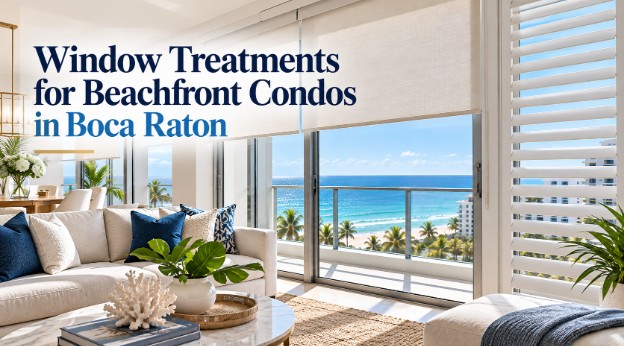
Beachfront condos need window treatments built around three coastal problems: salt corrosion, direct glare, and glass-wall privacy.
In the oceanfront units Boca Blinds services, metal components typically show wear before fabric does, eastern light washes out screens and fades flooring, and floor-to-ceiling sliders leave living areas exposed after dark.
Composite shutters, solar screen shades, and sealed motorized systems address all three in one specification. Boca Blinds designs and installs custom window treatments for oceanfront units across Boca Raton.
Key Takeaways
- Corrosion risk concentrates in hardware — springs, brackets, fasteners, and tracks — while fabric degrades through a different path of UV fading and mildew staining.
- Composite shutters, marine-finished aluminum, and synthetic screen fabrics are the materials Boca Blinds specifies most often for oceanfront exposure.
- Solar shades specified by openness factor control glare while keeping the ocean horizon visible.
- A condominium’s declaration and architectural standards, rather than any single statute, usually control the appearance of window coverings visible from outside.
Salt air and afternoon glare punish the wrong specification fast. Boca Blinds measures every opening on site — request a consultation before ordering.
Why Do Beachfront Condos Need Different Window Treatments?
Oceanfront units face a combination of chloride exposure, sustained humidity, and unobstructed solar load that inland homes rarely experience. Salt aerosol does not stop at the dune line. It drifts across balconies, settles on frames and tracks, and draws moisture from the air onto exposed metal surfaces.
Manufacturers evaluate coastal durability using accelerated salt fog exposure under ASTM B117, a test method that compares relative corrosion resistance between materials and coatings rather than certifying any product as coastal rated.
Humidity compounds the problem. Sliding doors stay open, corridors and elevators move damp air through units, and seasonal residents often leave cooling systems idling for months.
The Environmental Protection Agency recommends keeping indoor relative humidity below 60%, and ideally between 30% and 50%, in its mold and moisture guidance. Fabric held in damper conditions than that tends to show odor and mildew staining along the bottom rail first.
Solar load finishes the list. East-facing Boca Raton towers take direct sun from first light through late morning, with reflected light off the water extending the exposure. The same wall of glass that sells the unit also fades hardwood, heats the living area, and makes screens hard to read for hours each day.
Treatments chosen for an inland living room often struggle with that cycle, which is why oceanfront specifications start with hardware finish and fabric composition rather than color.
On exposed elevations, slat material and finish decide the best blinds for Florida sun.
Which Window Treatment Materials Hold Up Against Salt Air?
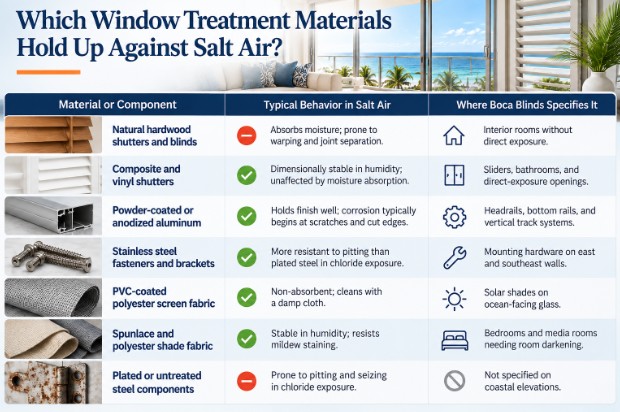
Synthetic and sealed materials generally outperform natural ones in coastal units. Untreated wood absorbs moisture, bare steel pits, and some painted finishes chalk under combined salt and UV exposure.
The table below summarizes the material categories Boca Blinds specifies most often for oceanfront buildings, including plantation shutters built for humid rooms.
| Material or Component | Typical Behavior in Salt Air | Where Boca Blinds Specifies It |
| Natural hardwood shutters and blinds | Absorbs moisture; prone to warping and joint separation | Interior rooms without direct exposure |
| Composite and vinyl shutters | Dimensionally stable in humidity; unaffected by moisture absorption | Sliders, bathrooms, and direct-exposure openings |
| Powder-coated or anodized aluminum | Holds finish well; corrosion typically begins at scratches and cut edges | Headrails, bottom rails, and vertical track systems |
| Stainless steel fasteners and brackets | More resistant to pitting than plated steel in chloride exposure | Mounting hardware on east and southeast walls |
| PVC-coated polyester screen fabric | Non-absorbent; cleans with a damp cloth | Solar shades on ocean-facing glass |
| Spunlace and polyester shade fabric | Stable in humidity; resists mildew staining | Bedrooms and media rooms needing room darkening |
| Plated or untreated steel components | Prone to pitting and seizing in chloride exposure | Not specified on coastal elevations |
These are material-category tendencies, not finished-product guarantees.
Actual performance depends on construction, coating thickness, fastener selection, installation, and the manufacturer’s own specifications, which is why a composite shutter hung on plated hinges still fails at the hinge, and an aluminum headrail with a scratched coating corrodes outward from the scratch.
Specifying hardware consistently across the whole unit prevents one low-grade component from setting the replacement schedule.
How Can Oceanfront Condos Control Glare Without Losing the View?
Openness factor controls glare. Solar screen fabric is woven to a stated percentage of open area, and that number determines how much light passes through and how much of the view survives.
In specifications Boca Blinds writes for oceanfront buildings, a 3% weave is the common starting point for direct eastern glare because it leaves the horizon readable, while a 5% weave brightens the room and returns more of the view at the cost of early-morning glare.
Orientation, glazing type, interior lighting, and individual glare tolerance all shift that recommendation, so confirm the final weave with samples held at the actual window.
Fabric color changes the result as much as the weave does. Darker screens absorb light and tend to preserve view clarity, while lighter screens reflect more solar energy but scatter transmitted light into a haze.
Oceanfront living rooms frequently land on a dark charcoal or bronze screen for view retention, with a lighter fabric reserved for west-facing bedrooms.
Layering solves what a single treatment cannot. A solar window shade handles daytime glare, and a second room-darkening or sheer layer handles evening privacy and sleep.
When energy performance drives the decision, the Department of Energy reports that tightly installed cellular shades can reduce unwanted solar heat gain through windows by up to 60% during cooling seasons, and the Attachments Energy Rating Council publishes comparative performance ratings for shades and blinds.
For light filtering with a softer finish, sheer shadings such as Silhouette and Nantucket diffuse direct sun while holding the outward view.
Unreadable screens and faded floors trace back to one bad fabric choice. Boca Blinds brings samples to the unit and tests them against actual exposure — book a measurement.
What Privacy Options Work in High-Rise Condos at Night?
Daytime privacy and nighttime privacy are separate problems with separate solutions. Solar screens that block sightlines during daylight reverse after dark, when interior lighting turns the glass into a lit display visible from adjacent towers and balconies.
An oceanfront specification that stops at a single screen layer leaves bedrooms and bathrooms exposed every evening.
Dual roller systems mount two fabrics on one bracket set, pairing a daytime screen with a room-darkening panel on the same opening.
Top-down bottom-up cellular shades reach a similar result differently, lowering from the top to keep sky and horizon visible while covering the lower glass where sightlines actually land.
Operation becomes a safety question on tall sliders. The Consumer Product Safety Commission adopted a mandatory standard for operating cords on custom window coverings under 16 CFR Part 1260, treating accessible cords longer than eight inches as a strangulation hazard to children eight and younger, and it continues to recommend cordless window coverings in any room a child may enter.
Cordless lift systems and motorized window coverings remove the cord entirely.
Most motorized systems enclose the motor within the headrail, though housing and ingress ratings vary by manufacturer and should be confirmed against the product specification for balcony-adjacent openings.
What Drives the Cost of Window Treatments in a Beachfront Condo?
Opening size drives cost first. A beachfront unit is mostly glass, and ten-foot sliders and stacked fixed panels require wider headrails, heavier fabric rolls, and reinforced mounting that standard residential sizes do not.
Because each panel is cut to its measured opening, online price ranges say little about a specific unit, and an on-site quote is the figure to plan around.
Specification Factors
Hardware grade, fabric composition, and motorization account for most of the spread between quotes. Marine-grade finishes and stainless fasteners cost more than plated components.
Motorized systems add motor, power source, and programming at each opening, though battery-powered options avoid the expense of running new wiring through finished concrete.
Building and Access Factors
High-rise installation carries costs that ground-floor work does not. Across the oceanfront buildings Boca Blinds installs in, service elevator reservations, certificate-of-insurance filings, restricted work windows, and balcony-side access are routine scheduling constraints that affect labor.
Association requirements can add a second cost layer when a declaration specifies a uniform street-side color, since a compliant liner or backing may then be required on every exterior-facing opening.
Oceanfront buildings in Delray Beach and Boynton Beach apply these rules as commonly as Boca Raton towers do.
Replacement cycles belong in the same calculation. Systems built on low-grade plated hardware are the ones Boca Blinds returns to replace soonest on direct oceanfront elevations, while correctly specified systems typically stay in service far longer and can often be repaired rather than replaced.
What Specification Mistakes Do Beachfront Condo Owners Make Most Often?
Three mistakes account for most of the replacement work Boca Blinds performs in oceanfront buildings, and each one is avoidable at the quoting stage.
- Choosing fabric before hardware. Color and weave get decided first, and the bracket, fastener, and track metallurgy that determine service life get accepted by default from whatever the quote includes.
- Assuming daytime privacy continues after dark. A solar screen that blocks sightlines at noon becomes transparent once interior lights come on, which surfaces as a complaint weeks after installation rather than at selection.
- Ordering before confirming exterior-facing requirements. A board that specifies a uniform street-side color can require replacement of an otherwise correct order, and the liner question is cheaper to answer before fabrication than after.
Routine cleaning sits just behind those three. Salt deposits left on tracks and bottom rails are abrasive, and the usual steps for keeping blinds clean apply with more urgency on a balcony-facing opening than on an inland window.
How Should Condo Owners Choose Between the Options?
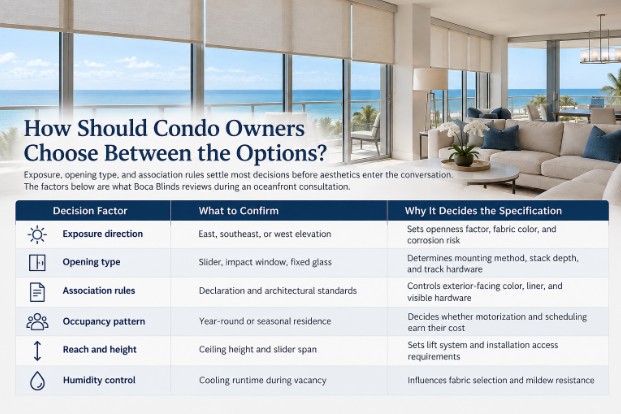
Exposure, opening type, and association rules settle most decisions before aesthetics enter the conversation. The factors below are what Boca Blinds reviews during an oceanfront consultation.
| Decision Factor | What to Confirm | Why It Decides the Specification |
| Exposure direction | East, southeast, or west elevation | Sets openness factor, fabric color, and corrosion risk |
| Opening type | Slider, impact window, fixed glass | Determines mounting method, stack depth, and track hardware |
| Association rules | Declaration and architectural standards | Controls exterior-facing color, liner, and visible hardware |
| Occupancy pattern | Year-round or seasonal residence | Decides whether motorization and scheduling earn their cost |
| Reach and height | Ceiling height and slider span | Sets lift system and installation access requirements |
| Humidity control | Cooling runtime during vacancy | Influences fabric selection and mildew resistance |
Association approval deserves early attention, and the authority usually sits in the building’s own documents rather than in statute.
Florida Statutes § 718.113 governs material alterations and substantial additions to common elements, requiring approval under the procedure in the declaration or, where the declaration is silent, by 75% of total voting interests.
Blinds and shades mounted inside a unit usually fall outside that common-element test, so color, liner, and visible hardware are typically governed by the declaration and the association’s exterior appearance standards.
Confirming both documents, and submitting a written specification sheet when the board requires one, prevents a forced replacement later.
Installation standards close the gap between a good specification and a good result.
Boca Blinds keeps measurement and installation in-house rather than subcontracting, so the team that measures each opening is the team that fits it, and every unit is checked for square, level, and clearance against the glass before sign-off. Finished oceanfront projects appear in the Boca Blinds project gallery.
Frequently Asked Questions
Do window treatments corrode in beachfront condos?
Metal components usually fail first. Exposed springs, cord locks, and unfinished brackets corrode on oceanfront elevations, while fabric degrades differently through UV fading and mildew staining. Powder-coated aluminum, stainless fasteners, and synthetic fabrics hold up longest in Boca Raton units.
What openness factor works best for ocean-facing windows?
A 3% openness screen controls direct eastern glare while keeping the horizon visible, and a 5% weave brightens the room with more sunrise glare. Orientation, glazing, fabric color, and personal glare tolerance shift that choice, so on-site sample testing settles it.
Does a condominium association have to approve new window coverings?
Approval depends on the declaration, not on a single statute. Florida Statutes § 718.113 governs material alterations to common elements, while architectural standards in the declaration typically control exterior-facing appearance. Checking both before ordering prevents a forced replacement. Written specifications satisfy most boards.
Are motorized shades practical in oceanfront high-rise units?
Motorization suits tall sliders and fixed glass that residents cannot reach safely. Most systems enclose the motor inside the headrail, though enclosure ratings vary by manufacturer. Scheduled operation also closes shades during peak afternoon heat in units that sit empty seasonally.
How long do window treatments last in a beachfront condo?
Lifespan depends more on hardware grade, coating quality, and exposure than on fabric alone. Composite shutters and marine-finished aluminum systems hold up longest on oceanfront elevations in Boca Blinds installations. Periodic rinsing of tracks and brackets follows most manufacturer maintenance instructions.
Can plantation shutters be used in a beachfront condo?
Composite and vinyl plantation shutters perform well in oceanfront units because the panel material resists moisture swelling. Natural wood belongs in interior rooms away from direct exposure. Hinge and fastener metallurgy affects durability as much as the panel material.
What window treatments work on floor-to-ceiling sliding glass doors?
Vertical track systems, panel tracks, and wide roller shades work best on floor-to-ceiling sliders because they stack clear of the operating panel. Headrail length and stack depth determine the choice, and heavier spans usually require motorized lift for safe daily operation.
Do solar shades stop furniture and flooring from fading?
Solar screen fabric blocks a substantial share of ultraviolet light and slows fading on hardwood, rugs, and upholstery. Fading still occurs because visible light and heat contribute, too. Lower openness percentages and darker weaves provide stronger protection on east-facing glass.
How are window treatments cleaned in a salt-air condo?
Screen and vinyl surfaces wipe clean with a damp cloth and mild soap. Tracks, brackets, and bottom rails collect salt deposits and benefit from periodic rinsing. Manufacturer care instructions govern each product, and abrasive cleaners or solvents strip protective coatings.
Should a seasonal condo have different window treatments than a year-round home?
Seasonal units benefit from scheduled motorization and room-darkening layers that stay closed during vacant months, limiting heat gain and fading. Year-round residences prioritize daily operation and view retention instead. Humidity control during vacancy also influences which fabrics remain mildew-free.
Bottom Line
Corrosion resistance, glare control, and layered privacy define a workable beachfront condo specification.
Hardware grade and coating quality carry most of the service-life risk; openness factor and fabric color determine whether the ocean view survives the glare fix; a second fabric layer handles the privacy that daytime screens surrender after dark.
Association documents and opening dimensions shape the final order, so both belong in the conversation before fabric is selected.
Oceanfront glass punishes guesswork, and a replacement cycle costs more than the right specification did. Boca Blinds has outfitted South Florida windows since 1976 — start with a measurement.