

HOA-friendly exterior appearance means a window treatment presents the color and finish an association’s governing documents require from outside, while room-side design choices stay as open as the documents and Florida law allow.
The outward-facing layer carries most of the compliance burden. Lined shades, dual-sided rollers, and white-finish shutters satisfy that layer without dictating the interior.
Boca Blinds specifies custom window treatments built to meet those standards.
Key Takeaways
- Florida’s Homeowners’ Association Act limits association control over interior changes that are not visible from specified outside vantage points.
- The outward-facing layer of a window treatment is usually visible from the frontage, so it remains subject to the declaration and published architectural standards.
- Lined and dual-sided products let the exterior face meet a uniform requirement while the room side follows the homeowner’s design.
- An association denying an architectural application must identify in writing the specific rule relied on and the nonconforming element.
Rejected orders cost weeks and a second deposit. Boca Blinds writes association-ready specifications before fabrication begins — schedule a measurement on site.
What Does an HOA Actually Control About Window Treatments?
Visibility and the governing documents set the boundary together. Florida Statutes § 720.3035, as amended effective July 1, 2024, prohibits an association or its architectural committee from adopting or enforcing a covenant, rule, or guideline that limits or places requirements on the interior of a structure when the interior is not visible from the parcel’s frontage, an adjacent parcel, an adjacent common area, or a community golf course.
The statute does not mention window treatments specifically. Boca Blinds applies it as a practical rule of thumb: the outward-facing layer shows through the glass and is typically subject to exterior-appearance standards, while room-side fabric that cannot be seen from those vantage points generally falls outside them.
Whether a particular product, opening, or lighting condition counts as visible depends on the facts and on the community’s declaration, so the declaration and published standards remain the first documents to read.
The same section also limits improvised enforcement. An association may not rely on a policy or restriction that is inconsistent with the declaration or its published guidelines, whether applied uniformly or not.
If a requirement appears in neither document, ask in writing before changing an order. Questions about how the statute applies to a specific property belong with an attorney.
Condominiums operate under a separate chapter. Florida Statutes § 718.113 ties material alterations and substantial additions to common elements to the declaration’s approval procedure, or to 75% of total voting interests where the declaration is silent.
Interior window coverings inside a unit are not automatically a material alteration of a common element, so condominium owners, including those choosing window treatments for beachfront condos, should rely on the declaration and architectural standards rather than assume the statute settles the question.
What Changes for HOA Compliance, and What Stays the Same?
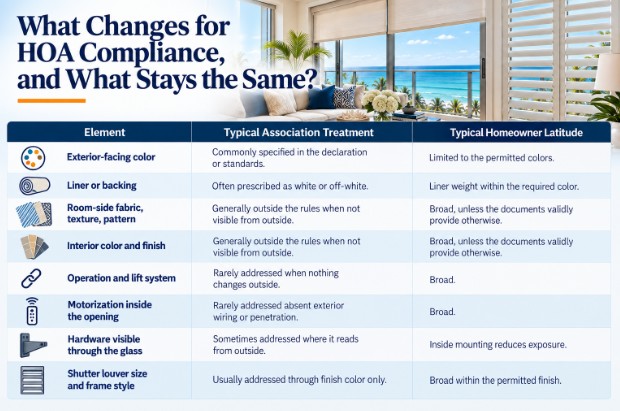
Compliance usually reshapes one layer of the product. The table below reflects how Boca Blinds sees these elements treated across the association-controlled projects it specifies, subject to each community’s governing documents.
| Element | Typical Association Treatment | Typical Homeowner Latitude |
| Exterior-facing color | Commonly specified in the declaration or standards | Limited to the permitted colors |
| Liner or backing | Often prescribed as white or off-white | Liner weight within the required color |
| Room-side fabric, texture, pattern | Generally outside the rules when not visible from outside | Broad, unless the documents validly provide otherwise |
| Interior color and finish | Generally outside the rules when not visible from outside | Broad, unless the documents validly provide otherwise |
| Operation and lift system | Rarely addressed when nothing changes outside | Broad |
| Motorization inside the opening | Rarely addressed absent exterior wiring or penetration | Broad |
| Hardware visible through the glass | Sometimes addressed where it reads from outside | Inside mounting reduces exposure |
| Shutter louver size and frame style | Usually addressed through finish color only | Broad within the permitted finish |
A homeowner who selects fabric before confirming the exterior requirement risks reordering the whole product instead of just one layer.
A product with a dedicated exterior-facing liner separates those decisions, which is why lined shades and dual-sided rollers appear so often in Boca Blinds specifications for covenant-controlled homes.
Which Window Treatments Satisfy Exterior Appearance Rules?
Several product categories resolve the conflict by construction rather than compromise. Plantation shutters in white or off-white present a consistent architectural face through the glass, and in Boca Blinds’ experience, boards seldom regulate louver size or frame profile beyond the finish color.
Lined roller and solar products work differently. A solar window shade can carry a neutral exterior-facing surface while the room-side weave stays dark for view retention, and a dual-sided roller places two fabrics on one roll.
Cellular shades are widely available with white street-side faces across many interior colors. The Department of Energy’s cellular shades fact sheet credits snug-fitting cellular shades with cutting summer solar heat gain at the window by as much as 60%.
Soft treatments need more attention. Draperies and soft treatments show their lining through the glass, so Boca Blinds normally specifies a white or ivory lining regardless of the face fabric. Where boards restrict visible hardware, inside mounting keeps brackets behind the frame line.
Operation rarely enters the review. Motorized window coverings change nothing an outside observer sees.
Cord rules apply here too: the Consumer Product Safety Commission’s 2022 standard at 16 CFR Part 1260 limits custom window coverings to cordless operation, short or inaccessible cords, or compliant restraint devices, and the agency recommends cordless products wherever young children live or visit.
Examples of association-approved installations are collected in the project gallery.
Board approval turns on documentation, not persuasion. Boca Blinds supplies fabric, color, and liner specifications for architectural review — request a consultation early.
What Does HOA Compliance Add to the Cost?
Compliance changes the specification more often than the total. Across the product lines Boca Blinds carries, a white or off-white exterior face is typically offered as a standard color, so a color requirement alone rarely adds cost.
The increase appears where a product must be built in two layers instead of one.
Where the Price Moves
Lined and dual-sided construction carries a higher material cost than an unlined equivalent, because the product uses two fabrics and heavier roll hardware. Drapery lining adds yardage and labor. Those increases scale with opening size rather than with the strictness of the association.
Where the Real Expense Hides
A rejected order is the expensive outcome. Custom treatments are fabricated to the measured opening, and under most manufacturer policies Boca Blinds works with, a finished custom product cannot be returned or reused on a different window. Replacing the exterior layer after fabrication costs more than specifying it correctly at the quote stage.
Communities across Parkland and Wellington enforce exterior-appearance standards as consistently as Boca Raton associations do.
Published price ranges transfer poorly to custom work, since every panel is made to a measured opening and a site quote remains the only reliable figure.
How Should an Architectural Review Request Be Submitted?
Documentation decides most reviews. Boca Blinds recommends a submission covering five items, the details committees in its service area most often ask for:
- Product type and construction (single-layer, lined, or dual-sided)
- Exterior-facing color
- Liner or backing specification
- Mounting method
- A physical fabric sample or manufacturer swatch
Denials are more useful than owners expect. Section 720.3035 requires an association denying an application for a structure or improvement to give written notice stating with specificity the rule or covenant relied on and the aspect of the proposal that does not conform. That notice usually narrows a resubmission to the single element named.
Timing matters more than argument. Submitting before fabrication means a denial costs a revision, not a replacement.
On many product lines, Boca Blinds can change a liner selection without penalty until the order releases to production, and the cutoff varies by manufacturer. The Boca Blinds installation process begins only after approval is in hand.
Which Factors Decide the Final Specification?
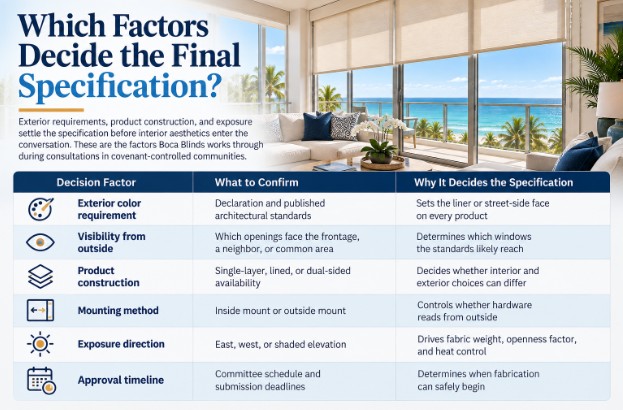
Exterior requirements, product construction, and exposure settle the specification before interior aesthetics enter the conversation. These are the factors Boca Blinds works through during consultations in covenant-controlled communities.
| Decision Factor | What to Confirm | Why It Decides the Specification |
| Exterior color requirement | Declaration and published architectural standards | Sets the liner or street-side face on every product |
| Visibility from outside | Which openings face the frontage, a neighbor, or common area | Determines which windows the standards likely reach |
| Product construction | Single-layer, lined, or dual-sided availability | Decides whether interior and exterior choices can differ |
| Mounting method | Inside mount or outside mount | Controls whether hardware reads from outside |
| Exposure direction | East, west, or shaded elevation | Drives fabric weight, openness factor, and heat control |
| Approval timeline | Committee schedule and submission deadlines | Determines when fabrication can safely begin |
Installation closes the remaining gap. Boca Blinds uses its own crews to measure and install, and each finished window is checked for square, level, and consistent reveal across the elevation — the detail a board notices from the street.
Wood and faux wood blinds remain available in association-compliant finishes for a traditional look.
Frequently Asked Questions
Can an HOA tell homeowners which window treatments to install?
An HOA can regulate what its documents cover and what shows from outside. Section 720.3035 bars restricting interior changes not visible from the frontage, adjacent parcels, common areas, or community golf course. A covering’s street-side face usually remains visible and therefore regulated.
Why do associations specify a white or off-white street-side appearance?
Uniformity drives the rule. A single exterior-facing color keeps elevations consistent regardless of each owner’s interior choice. White and off-white are the requirements Boca Blinds encounters most often across South Florida associations, though each declaration sets the exact standard.
Does a white liner limit interior fabric choices?
A liner separates the two sides. The exterior-facing layer meets the association requirement while room-side fabric, texture, and color generally remain open, subject to the governing documents. Liners are available across cellular, roller, roman, and drapery products, with options varying by line.
Do condominium rules differ from HOA rules?
Yes. Chapter 718 governs condominiums and ties material alterations of common elements to the declaration’s approval procedure, while Chapter 720 governs homeowners’ associations and parcel-level architectural control. Both point to each community’s recorded documents and published standards for the practical answer.
What happens when an architectural review committee denies a request?
Florida law requires written notice. Under Section 720.3035, an association denying an application must specify the rule or covenant relied on and the aspect of the proposal that fails to conform. That notice usually identifies the single element to revise.
Can plantation shutters be installed in an HOA community?
Plantation shutters suit association communities because the louver face reads as a consistent architectural element from outside. White and off-white finishes meet the exterior standards Boca Blinds sees most often. Frame style and louver size usually remain open within the permitted finish.
Does motorization require association approval?
Motorization sits inside the home and usually leaves the exterior unchanged, so it rarely triggers review on its own. Wiring that penetrates an exterior wall or shared structure changes that analysis and belongs in the submission. Battery-powered motors typically avoid that question entirely.
How much does HOA compliance add to the price of window treatments?
Compliance mostly affects construction, not total cost. Lined and dual-sided products cost more than unlined equivalents, while a white exterior face is usually standard. Replacing a rejected custom order is the expensive outcome planning prevents.
What documentation do boards typically request?
Boca Blinds recommends submitting product type, exterior-facing color, liner or backing specification, mounting method, and a fabric sample. Those five items match what committees in its service area most often request, and a single specification sheet with them typically shortens review time.
Can an association enforce a rule that is not in the declaration?
Section 720.3035 bars an association from relying on a policy or restriction inconsistent with the declaration or published guidelines, whether applied uniformly or not. Requesting the written standard behind an instruction clarifies its basis. Property-specific legal questions belong with an attorney.
Bottom Line
Exterior visibility and the governing documents together decide what an association controls.
Florida law keeps non-visible interior changes largely outside a board’s reach, while the outward-facing layer usually remains subject to the declaration and published standards.
Lined shades, dual-sided rollers, and white-finish shutters resolve both sides in one product, so compliance typically costs a liner rather than a design. Confirming the exterior requirement before fabrication separates a routine approval from a replaced order.
Compliance questions get expensive after fabrication. Boca Blinds has specified window treatments for South Florida homes since 1976 — book an in-home measurement.