

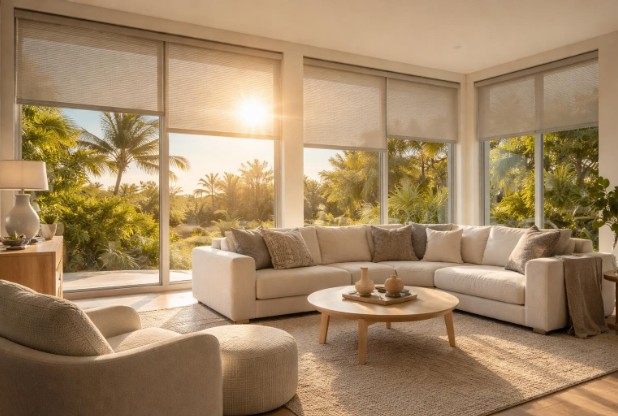
The openness factor is the percentage of open space in a solar shade’s woven fabric: a 3% shade allows 3% of incoming light to pass through and blocks the remaining 97%.
Solar shades control heat, but the openness factor determines how much protection each shade provides.
For west-facing living rooms and great rooms in Boca Raton, a 3%–5% openness factor in dark fabric delivers the strongest balance of afternoon heat rejection, daytime privacy, and preserved outward view.
A 1%–3% openness factor is the correct choice for west-facing home offices, media rooms, and bedrooms where screen glare or sleep quality is the priority.
Openness factors above 10% allow too much solar heat gain to pass through west-facing glass in South Florida’s climate.
Key Takeaways
- West-facing windows in Boca Raton require solar shades with 3%–5% openness to balance afternoon heat rejection with outward visibility.
- A 1%–3% openness factor delivers maximum heat control for functional rooms such as home offices and media rooms.
- Dark fabric improves view clarity and glare control at any openness percentage — a dark 3% shade produces sharper outward views than a light-colored 5% shade at the same west exposure.
What Is the Openness Factor in Solar Shades?
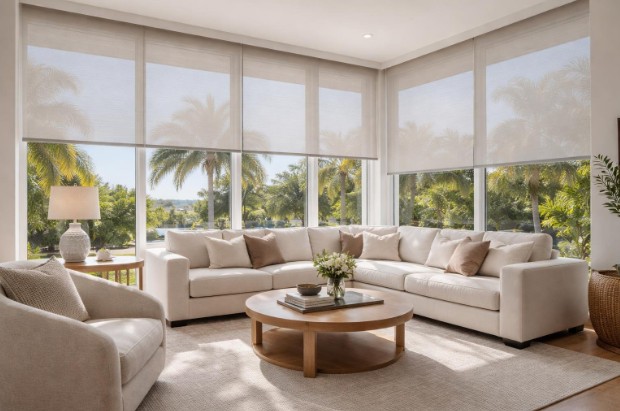
The openness factor is the percentage of open space in a solar shade’s woven fabric. A 3% openness shade blocks 97% of incoming light; a 10% openness shade blocks 90% of it.
The openness factor is the ratio of open space to woven yarn across the total fabric surface area of a solar shade. A lower openness percentage indicates a tighter weave that blocks more light and heat.
A higher openness percentage indicates a looser weave that transmits more light and preserves clearer outward views.
How Manufacturers Measure Openness Factor
Solar shade manufacturers measure the openness factor by calculating the ratio of open space to woven yarn across the fabric’s total surface area. Under magnification, solar shade fabric displays a basketweave pattern — small open gaps between interlocked yarns.
A 1% openness factor means 1% of the fabric surface is open space and 99% is solid material. A 10% openness factor means 10% is open and 90% is solid. Residential solar shades are available in openness ratings from 0% (fully opaque) to 14%, with 1%, 3%, 5%, and 10% representing the most common options.
The U.S. Department of Energy identifies solar shades as an effective window covering strategy for reducing solar heat gain in hot climates.
Openness factor is a fabric-level specification independent of fabric color — color is a separate performance variable that interacts with openness factor but does not alter the rating itself.
West-facing windows losing the battle against the afternoon sun? Boca Blinds offers free in-home consultations to find the right solar shade openness factor for your Boca Raton home. Book Your Free Consultation
Why Openness Factor Matters More Than Any Other Shade Specification
The openness factor simultaneously controls heat rejection, glare reduction, outward view clarity, and daytime privacy — no other shade specification affects all four performance variables at once.
A 1% openness solar shade blocks approximately 95% of solar heat and delivers maximum daytime privacy, but limits outward visibility to general shapes and movement.
A 5% openness shade maintains good outward view clarity while rejecting approximately 90% of solar heat.
For west-facing windows in Boca Raton, where afternoon sun strikes the glass at a low angle and drives the day’s highest indoor temperatures, selecting the wrong openness factor can either overheat the room or sacrifice the outward view without measurable benefit.
Boca Blinds’ in-home consultations across Palm Beach County consistently identify west-facing glass as the room exposure where openness factor selection produces the largest measurable impact on daily comfort.
Why West-Facing Windows in Boca Raton Are the Hardest Exposure to Treat
West-facing windows in Boca Raton receive direct, low-angle afternoon sun that penetrates deeper into rooms than overhead midday sun and produces the highest solar heat gain of any window orientation in the home.
Boca Raton’s latitude of approximately 26.4° North amplifies this effect year-round, making west-facing windows the most demanding for solar shade selection in South Florida.
How Boca Raton’s Latitude and Sun Angle Change the Calculation
Boca Raton sits at approximately 26.4° North latitude, a position that produces low-angle afternoon sun on west-facing glass throughout the year.
Low-angle sun strikes window glass more nearly perpendicular to the surface than high-angle midday sun, which maximizes solar heat transfer through the pane.
Low-angle sun also bypasses roof overhangs and exterior awnings that effectively shade overhead glass, making these architectural features less useful on west exposures.
According to the U.S. Department of Energy, west-facing windows during the afternoon hours represent one of the highest solar heat-gain scenarios in residential buildings in hot climates.
West-facing floors, upholstery, and artwork in Boca Raton homes receive direct UV exposure during peak-intensity afternoon hours — the primary driver of premature fading in South Florida interiors.
A solar shade with a 3%–5% openness factor intercepts this low-angle radiation at the glass surface, reducing UV transmission by 95%–97% regardless of sun angle.
The Afternoon Thunderstorm Factor Unique to South Florida
Boca Raton’s summer thunderstorm pattern typically produces storms between 2 PM and 5 PM — overlapping directly with peak west-window solar intensity. Before a storm arrives, west-facing rooms absorb maximum afternoon heat.
After the storm clears, strong late-afternoon sun resumes for one to two hours before sunset. Manual shade operation during this cycle — lower for peak sun, raise during the storm, lower again for post-storm sun — is impractical on multi-window west exposures.
Motorized solar shades with programmable schedules lower automatically at a set hour and retract via wind sensors before storm gusts damage the fabric.
Post-storm humidity raises indoor moisture levels, increasing the load on air conditioning systems already working against west-facing solar heat gain — a compounding effect that proper window treatments measurably reduce.
The Openness Factor Scale — What Each Percentage Delivers on West-Facing Glass
For west-facing windows in Boca Raton, the effective openness factor ranges from 1% to 10%. A 1%–3% openness shade delivers maximum heat rejection; a 3%–5% shade balances heat control with clear outward views; a 7%–10% shade prioritizes view preservation at the cost of higher heat gain.
| Openness Factor | Heat Rejection | Glare Control | View Clarity | Best West-Exposure Application |
| 1%–2% | ~95% | Maximum | Minimal | Home office, media room, west-facing bedroom |
| 3%–5% | ~90% | High | Good | Living room, great room, dining room |
| 7%–10% | ~85% | Moderate | Excellent | Scenic-view rooms with exterior shade layer |
| 10%–14% | ~80% | Low | Maximum | Not recommended for west exposure in South Florida |
1%–3% Openness — Maximum Heat Control for Functional West-Facing Rooms
A 1%–3% openness solar shade blocks approximately 95%–97% of solar heat and delivers maximum daytime privacy — the correct specification for west-facing home offices, media rooms, and bedrooms in Boca Raton, where screen glare or sleep quality is the priority.
At 1%–2% openness, outward visibility is limited to general shapes and movement; faces and fine detail are not distinguishable through the fabric. At 3% openness, a dark-fabric shade restores significantly more view clarity while maintaining heat rejection above 90%.
Homeowners who require complete nighttime privacy should pair a 1%–3% solar shade with a double roller system that adds a blackout layer behind the solar fabric.
3%–5% Openness — The West Exposure Standard for Living Spaces
A 3%–5% openness factor is the most frequently specified range for west-facing living rooms, great rooms, and dining areas in Boca Raton homes.
A 3% dark-fabric shade rejects approximately 90%–97% of solar heat while maintaining clear outward views — the reason local window treatment professionals cite 3% west-facing as their most common recommendation for Palm Beach County living spaces.
A 5% shade is appropriate when the room benefits from a deep overhang, covered lanai, or adjacent structure that reduces direct west-afternoon sun before it reaches the glass.
The best window fabrics for Florida’s climate combine a 3%–5% openness rating with UV-stable yarns that resist color shift under sustained exposure to the South Florida sun.
7%–10% Openness — When View Preservation Justifies the Trade-Off
A 7%–10% openness factor delivers maximum view clarity — the appropriate choice when a west-facing window frames an Intracoastal view, lake, or golf course that the homeowner prioritizes over maximum heat rejection.
Each 5-percentage-point increase in openness reduces heat rejection by approximately 10%–15%, translating into a measurably higher cooling load on west-facing glass during the afternoon in Boca Raton.
Homeowners who select 7%–10% openness on west exposure should compensate by pairing the solar shade with an exterior shade layer or a layered window treatment system that intercepts solar heat before it reaches interior glass.
Still unsure which openness factor fits your west-facing room? Boca Blinds brings samples directly to your home so you can evaluate them in real afternoon light. Schedule Your In-Home Visit
Fabric Color and Openness Factor — How the Two Variables Interact on West-Facing Glass
Fabric color and openness factor are independent specifications that interact to produce a solar shade’s actual performance. On west-facing glass in Boca Raton, dark fabric at 3% openness delivers better glare control and outward view clarity than light-colored fabric at the same 3% openness rating.
Dark Fabric — Superior View and Glare Control for West Exposure
Dark solar shade fabric — charcoal, black, or deep bronze — absorbs light at the yarn surface, reducing internal light scatter and producing a sharper, cleaner outward view through the weave.
The practical result: a dark 3% shade provides view clarity equivalent to a light-colored 5% shade, meaning homeowners who select dark fabric can choose a tighter openness factor without sacrificing sightlines.
For west-facing Boca Raton windows where afternoon glare is the primary complaint, dark fabric paired with 3%–5% openness is the standard professional recommendation.
Boca Blinds provides physical fabric samples for evaluation in the actual room at peak afternoon sun hours — the only reliable method for assessing how dark versus light fabric performs on a specific west exposure before purchase.
Light Fabric — When Reflectivity Outweighs View Quality
Light-colored solar shade fabric — white, ivory, and light gray — reflects solar radiation outward at the window surface, producing higher thermal reflectivity than dark fabric at the same openness factor.
The U.S. Department of Energy notes that medium-colored draperies with white backings reduce heat gain by approximately 33% on direct-sun windows — a comparable reflectivity principle applies to light-colored solar shade fabrics.
Light fabric is appropriate for west-facing rooms where thermal performance takes priority over outward view quality, such as utility rooms, west-facing bathrooms, or secondary bedrooms where sightlines are not a design priority.
The view through a light-fabric shade at 3% openness will appear hazier than through dark fabric at the same rating, because reflected exterior light scatters across the weave surface and reduces contrast.
Interior vs. Exterior Solar Shades for West-Facing Windows — Which Performs Better
Exterior solar shades outperform interior shades on west-facing windows because exterior shades intercept solar heat before it passes through the glass.
Interior solar shades manage heat that has already entered the room, which requires a tighter openness factor — typically 1%–3% — to compensate for that thermal disadvantage.
| Specification | Interior Solar Shades | Exterior Solar Shades |
| Heat interception point | After light passes through the glass | Before light reaches glass |
| Effective heat reduction | ~40% on direct-sun west exposure | Up to 80%–90% on direct-sun west exposure |
| Recommended openness (west exposure) | 1%–3% | 3%–5% acceptable |
| View preservation | Limited by the need for a tighter weave | Higher openness is viable without a heat penalty |
| Installation cost | Lower | Higher |
| Fabric selection | Broad — full residential range | Limited to weather-resistant fabrics |
| Maintenance requirement | Minimal — protected from elements | Regular — rain, wind, and salt air exposure |
| Motorization value | Recommended | Strongly recommended — wind sensor integration critical |
| Nighttime privacy | Pair with a double roller system | Solar fabric alone does not provide nighttime privacy |
| Best application | Most Palm Beach County homes | Large west-facing windows with a premium view or high cooling cost priority |
For west-facing rooms where cooling costs are the primary concern, motorized exterior solar shades programmed to lower at 1 PM stop solar heat before it loads the interior air mass — a performance level no interior shade matches at any openness factor.
The U.S. Department of Energy identifies exterior shading as the most effective residential strategy for reducing solar heat gain on direct-sun exposures.
How to Choose the Right Openness Factor for West-Facing Windows in Boca Raton
Selecting the correct openness factor for a west-facing Boca Raton window requires three sequential decisions: how much outward view to preserve, whether the shade mounts inside or outside the glass, and which fabric color fits the room’s afternoon light conditions.
A Six-Step Decision Framework
Step 1 — Identify the room’s primary function. West-facing home offices, media rooms, and bedrooms require maximum heat and glare control — specify 1%–3% openness. West-facing living rooms and dining rooms balance view with comfort — specify 3%–5% openness.
Step 2 — Determine installation position. Interior mounting requires a tighter openness factor than exterior mounting to achieve equivalent heat rejection. An interior 3% shade and an exterior 5% shade deliver comparable afternoon heat control on west-facing Boca Raton glass.
Step 3 — Select fabric color before selecting the final openness percentage. Dark fabric improves view clarity and glare control; light fabric improves thermal reflectivity. The fabric color decision may shift the correct openness percentage by one step in either direction.
Step 4 — Account for architectural shading. A deep overhang, covered lanai, or adjacent structure that shades west-facing glass between 2 PM and 4 PM allows one step looser openness — for example, 5% instead of 3% — without increasing afternoon heat gain.
Step 5 — Evaluate physical fabric samples in the room at 3 PM. West-facing afternoon light significantly changes the appearance and perceived performance of solar shade fabric compared to showroom or morning conditions. Request samples from Boca Blinds and assess them during peak sun hours before finalizing any openness specification.
Step 6 — Measure precisely and eliminate edge gaps. West-facing windows that are improperly fitted allow solar heat to bypass the shade at the frame edges and top rail. Professional installation eliminates edge-gap heat infiltration — a failure point that undermines openness-factor performance regardless of the selected percentage.
Stop overpaying to cool a room with the wrong shade. Boca Blinds specifies the correct openness factor for every west-facing window — and installs it precisely. Get Your Free Consultation Today
Frequently Asked Questions
What openness factor is best for west-facing windows in Boca Raton?
A 3%–5% openness factor in dark fabric is the standard recommendation for west-facing living spaces in Boca Raton. Home offices and media rooms facing west perform better at 1%–3%. Openness factors above 10% allow excessive afternoon solar heat gain in South Florida’s climate.
Can I still see outside through a solar shade on a west-facing window?
Yes. A 3% dark-fabric solar shade preserves clear outward views during daylight hours while blocking approximately 97% of incoming light. View clarity improves with darker fabric — a dark 3% shade delivers sharper sightlines than a light-colored 5% shade at the same exposure.
Do solar shades actually reduce heat from west-facing afternoon sun?
Yes. Interior solar shades at 3% openness reduce solar heat gain at the glass surface by approximately 90%–97%. Exterior solar shades intercept heat before it passes through the glass, reducing solar heat gain by up to 80%–90% — measurably outperforming interior-mounted shades on west exposure.
Do solar shades provide privacy at night on west-facing windows?
No. Solar shades provide daytime privacy only. At night, interior lighting reverses the effect — the shade becomes transparent from outside. West-facing rooms used in the evening require a blackout liner, double roller shade, or drapery panel for nighttime coverage.
What is the difference between the openness factor and the opacity in solar shades?
Openness factor and opacity are inverse measurements of the same specification. A 3% openness shade has 97% opacity. A 5% openness shade has 95% opacity. Manufacturers use the openness factor as the primary rating; opacity is the mathematical complement.
Should I choose dark or light fabric for west-facing solar shades in Boca Raton?
Dark fabric is the standard recommendation for west-facing windows. Dark fabric absorbs light at the yarn surface, producing sharper outward views and superior glare control. Light fabric reflects more solar heat outward but produces a hazier view — appropriate when thermal performance outweighs view quality.
Are exterior solar shades better than interior shades for west-facing windows?
Yes. Exterior solar shades block solar heat before it reaches the glass, reducing heat gain by up to 90%. Interior shades filter heat already inside the room, reducing it by approximately 40%. Exterior installation allows a looser openness factor — 5% versus 1%–3% interior — without sacrificing heat performance.
Should west-facing solar shades in Boca Raton be motorized?
Yes. South Florida’s afternoon thunderstorm pattern — typically 2 PM–5 PM — overlaps with peak west-window solar intensity. Motorized solar shades lower automatically at scheduled times and retract via wind sensors before storm gusts, eliminating the need for manual adjustment multiple times daily.
How long do solar shades last on west-facing windows in Florida?
High-quality solar shades installed on west-facing Florida windows typically last 7–12 years for exterior installations and up to 15 years for interior installations. UV-stable yarns, corrosion-resistant hardware, and regular cleaning every six months maximize lifespan in South Florida’s high-UV, high-humidity coastal environment.
Can overhangs or awnings replace solar shades on west-facing Boca Raton windows?
No. Roof overhangs and fixed awnings effectively shade overhead south-facing glass but cannot block low-angle afternoon sun on west-facing windows. West-facing glass requires operable shading — solar shades, exterior roller shades, or retractable awnings — that intercept the sun at a low horizontal angle.