

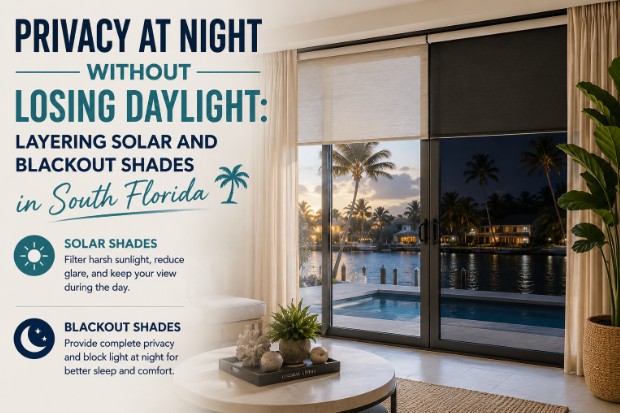
Layering a solar shade behind a blackout roller shade gives South Florida homeowners full daytime light filtering and complete nighttime privacy from a single window opening.
The solar shade blocks 70 to 95 percent of UV and glare during the day while preserving the outdoor view.
The blackout shade drops at night to eliminate 99 percent of light transmission and remove any interior visibility from outside. Boca Blinds has designed and installed layered shade systems across Boca Raton and Palm Beach County since 1976.
Key Takeaways
- A dual-roller system mounts two shades on one bracket, letting homeowners switch between daytime light filtering and nighttime blackout with separate controls.
- Solar shades alone do not provide nighttime privacy because interior lighting makes occupants visible through the mesh weave after dark.
- Blackout shades paired with solar shades eliminate the forced choice between daytime views and after-dark coverage.
- Professional installation ensures both shades clear each other’s cassettes and operate independently without fabric contact.
Interior lights turn solar shades into one-way mirrors at night, exposing every room to street view. Schedule a free layering consultation with Boca Blinds to solve both problems in one bracket.
Why Do Solar Shades Stop Working After Sunset?
Solar shades lose their privacy function after sunset because the mesh weave that filters daylight also transmits interior light outward. During the day, the brighter exterior overwhelms the view from outside, making the shade appear opaque to passersby.
At night, the light balance reverses — interior lamps, televisions, and overhead fixtures project silhouettes and room detail through the mesh at every openness percentage.
How Openness Percentage Drives the Reversal
Openness percentage measures the ratio of open space to fabric surface in a solar shade’s weave. A 1-percent openness fabric blocks more light and glare but still transmits enough interior illumination at night to reveal movement.
A 5-percent openness fabric offers a clearer daytime view but produces sharper nighttime silhouettes.
No openness percentage eliminates the problem entirely, because even the tightest weave lets enough light in to compromise privacy once the room is lit.
Coastal Proximity Makes the Problem Worse
South Florida’s latitude and building density amplify this issue. Homes in Boca Raton and coastal Palm Beach County face neighbors, sidewalks, and roadways within 15 to 40 feet of ground-floor glass.
West-facing windows that benefit most from solar shades during afternoon glare hours become the most exposed openings after dark because living rooms and kitchens behind those windows stay lit longest.
The U.S. Department of Energy confirms that interior window treatments reduce solar heat gain by up to 77 percent, but no single-layer solar product addresses the privacy reversal that occurs when artificial light replaces sunlight.
What Is a Dual-Roller System and How Does Layering Solve Both Problems?
A dual-roller system mounts two independent roller shades on a single shared bracket, stacking one shade behind the other within the same headrail footprint. The front shade — typically the solar screen — faces the glass and handles daytime UV and glare.
The rear shade — the blackout fabric — faces the interior of the room and deploys only when nighttime privacy is needed.
Bracket and Cassette Configuration
Both shades roll into separate cassettes housed inside one fascia cover that projects 4 to 6 inches from the wall or ceiling. The cassettes sit on offset axes so neither shade contacts the other during operation. Standard dual brackets accept fabric widths from 24 to 144 inches, covering single windows, sliding glass doors, and wide picture windows.
Separate Controls, Zero Compromise
Each shade operates on its own control — a continuous-loop chain, spring assist, or motorized drive. Homeowners lower the solar shade in the morning and leave it down all day, then lower the blackout shade behind it at night.
In the morning, the blackout retracts, and the solar shade stays in place. No manual swap or full retraction is needed between modes.
Scheduling Through Smart Home Platforms
Motorized dual-roller systems accept scheduling through Apple HomeKit, Google Home, Amazon Alexa, and Samsung SmartThings.
The solar shade can auto-deploy at sunrise, and the blackout shade can auto-deploy at sunset based on local astronomical timers. Motorized controls eliminate cord clutter and meet current ANSI/WCMA A100.1 child-safety standards.
Which Fabric Pairing Performs Best in South Florida’s Climate?
The strongest dual-roller pairing for South Florida homes places a 3-percent-openness solar fabric in front and a white-backed blackout fabric behind it. This combination delivers 80 to 90 percent glare reduction during the day and 99 percent light block at night without requiring any additional window treatment.
Choosing the Right Solar Mesh
Solar fabrics come in openness ranges from 1 percent to 14 percent. South Florida applications perform best at 1-5 percent, because higher openness percentages sacrifice too much UV protection in a climate with 240+ sunny days per year.
Dark-colored solar fabrics reduce glare more aggressively but absorb heat at the glass surface. Light-colored fabrics reflect more solar energy outward and keep the glass pocket cooler.
The National Fenestration Rating Council publishes solar heat gain coefficients that quantify this difference by fabric color and weave density.
Matching the Blackout Layer
Blackout fabrics use an opaque polymer coating or a multi-layer weave to block 99 percent or more of visible light. White-backed blackout fabrics reflect heat back toward the glass rather than absorbing it into the room.
This reflective quality matters in South Florida because the blackout shade may be deployed before sunset in the summer months, when homeowners want both privacy and heat rejection simultaneously.
Materials That Fail in Humid Coastal Environments
Natural fibers like linen and cotton break down under sustained UV exposure and high humidity. Woven bamboo and jute fabrics warp when relative humidity stays above 70 percent for consecutive months, a pattern that runs from June through October across Palm Beach County.
The National Oceanic and Atmospheric Administration documents this sustained humidity window annually for South Florida coastal zones.
How Much Does a Solar-Plus-Blackout Layered System Run in Boca Raton?
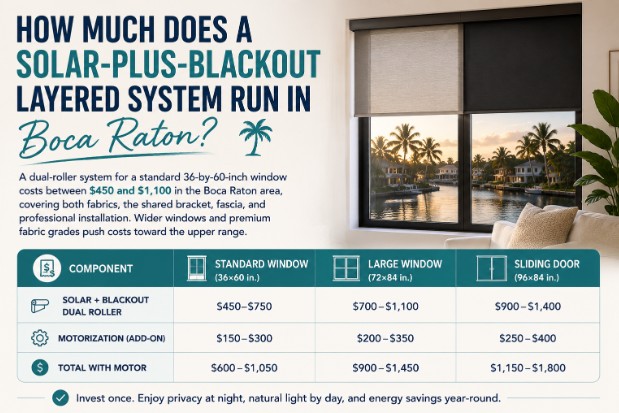
A dual-roller system for a standard 36-by-60-inch window costs between $450 and $1,100 in the Boca Raton area, covering both fabrics, the shared bracket, fascia, and professional installation. Wider windows and premium fabric grades push costs toward the upper range.
| Component | Standard Window (36×60 in.) | Large Window (72×84 in.) | Sliding Door (96×84 in.) |
| Solar + Blackout Dual Roller | $450–$750 | $700–$1,100 | $900–$1,400 |
| Motorization (add-on) | $150–$300 | $200–$350 | $250–$400 |
| Total with Motor | $600–$1,050 | $900–$1,450 | $1,150–$1,800 |
Key cost variables that shift the final price:
- Fabric grade determines the base cost — basic PVC-coated polyester runs 30 to 40 percent less than premium fiberglass-blend solar fabric.
- Cassette style affects bracket cost — a slim, square cassette costs $30 to $60 less per window than a curved designer fascia.
- Battery-powered motors cost less upfront but require recharging every 6 to 12 months; hardwired motors eliminate recharging but require low-voltage wiring to be routed during installation.
- Whole-home projects covering 8 or more windows typically qualify for volume pricing that reduces per-unit cost by 10 to 15 percent.
The Florida Building Commission exempts interior soft treatments from impact-resistance requirements in high-velocity hurricane zones, but exterior protection on the window itself may affect interior mounting depth and bracket clearance.
Rooms with south- or west-facing glass lose the most energy to uncontrolled solar gain. Request a free window assessment from Boca Blinds to get the right fabric pairing for each exposure.
Dual Rollers Versus Other Privacy-and-Light Solutions
Dual-roller shade systems outperform single-product alternatives on the specific combination of daytime light preservation and nighttime privacy. Other treatments solve one problem but compromise the other.
| Solution | Daytime Light | Daytime View | Nighttime Privacy | Estimated Cost (36×60 in.) |
| Dual Roller (Solar + Blackout) | Filtered, adjustable | Preserved through mesh | Complete blackout | $450–$750 |
| Single Blackout Shade | Blocked when deployed | Blocked when deployed | Complete blackout | $200–$450 |
| Single Solar Shade | Filtered | Preserved | Fails after dark | $200–$400 |
| Cellular/Honeycomb Shade | Diffused, not filtered | Obscured | Partial to full | $250–$500 |
| Sheer Shade (Silhouette) | Filtered through vanes | Preserved when open | Limited at night | $350–$650 |
| Curtains/Drapes | Blocked when closed | Blocked when closed | Full when closed | $300–$700 |
Additional factors that weigh into the decision:
- Single blackout shades force a binary choice — the room is either fully open or fully dark, with no filtered middle state for daytime use.
- Cellular shades diffuse light rather than filtering it, which softens the view and reduces contrast compared to a solar shade’s clear mesh.
- Sheer shades like Silhouette offer adjustable vanes for daytime control but still transmit enough interior light at night to reveal room occupants at close range.
- Curtains and drapes provide full nighttime coverage when closed but eliminate both daylight and the exterior view entirely, defeating the purpose for homeowners who chose glass walls for the sightline.
What to Expect During a Layered Shade Installation
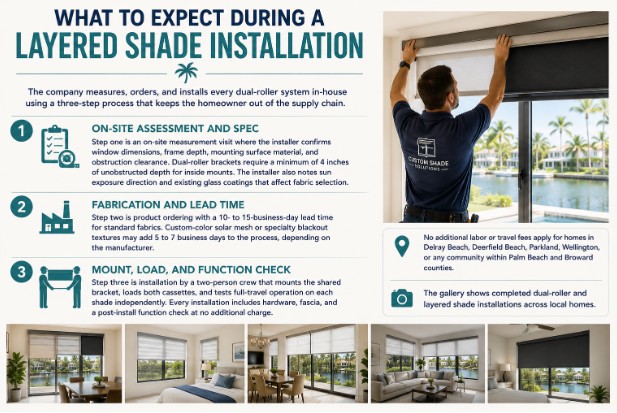
The company measures, orders, and installs every dual-roller system in-house using a three-step process that keeps the homeowner out of the supply chain.
On-Site Assessment and Spec
Step one is an on-site measurement visit where the installer confirms window dimensions, frame depth, mounting surface material, and obstruction clearance. Dual-roller brackets require a minimum of 4 inches of unobstructed depth for inside mounts. The installer also notes sun exposure direction and existing glass coatings that affect fabric selection.
Fabrication and Lead Time
Step two is product ordering with a 10- to 15-business-day lead time for standard fabrics. Custom-color solar mesh or specialty blackout textures may add 5 to 7 business days to the process, depending on the manufacturer.
Mount, Load, and Function Check
Step three is installation by a two-person crew that mounts the shared bracket, loads both cassettes, and tests full-travel operation on each shade independently. Every installation includes hardware, fascia, and a post-install function check at no additional charge.
No additional labor or travel fees apply for homes in Delray Beach, Deerfield Beach, Parkland, Wellington, or any community within Palm Beach and Broward counties. The gallery shows completed dual-roller and layered shade installations across local homes.
Frequently Asked Questions
Can I Retrofit a Blackout Shade Behind My Existing Solar Roller?
Retrofitting requires a dual bracket that accepts two cassettes in the same headrail space. If the current mount supports the added depth, the installer swaps the single bracket for a dual unit without patching the original screw holes in the frame.
Do Inside-Mounted Dual Rollers Fit Standard South Florida Window Frames?
Inside-mounted dual rollers need at least 4 inches of unobstructed frame depth to house both cassettes without fabric contact. Frames shallower than 4 inches require an outside mount that adds 2 to 3 inches of visible projection from the wall.
How Often Should I Clean Layered Shades in a Coastal Home?
Wipe solar mesh with a damp microfiber cloth quarterly to remove salt film and pollen. Blackout fabric follows the same schedule plus a mildew check along the bottom rail where moisture collects during South Florida’s June-through-October humidity season.
Will a 1-Percent Solar Shade Handle Direct West Afternoon Sun?
A 1-percent-openness solar fabric blocks 94 to 96 percent of UV and visible glare, making it the strongest daytime option for west-facing glass that absorbs direct sun from 2:00 p.m. to 5:00 p.m. April through September across Boca Raton.
Are Dual-Roller Systems Safer Than Curtains for Homes with Young Children?
Dual-roller shades ship cordless or motorized as standard under current ANSI/WCMA A100.1 requirements, eliminating accessible cords entirely. Curtains with tiebacks or pull cords present a strangulation risk that modern dual-roller cassette systems remove by design.
Every room with uncovered glass loses privacy the moment interior lights turn on. Book a free layering consultation with Boca Blinds and get the right solar-plus-blackout pairing matched to each window’s exposure and size.