

Plantation shutters in South Florida are interior window treatments built from adjustable louver panels mounted inside a rigid frame, engineered to withstand year-round humidity levels above 70% and daily UV exposure that degrades lesser coverings within 5–8 years.
Boca Blinds, a family-owned plantation shutter specialist operating in Boca Raton since 1976, measures every window on-site and installs every panel with in-house factory-trained technicians — never subcontractors.
The material, louver width, and frame configuration you select determine how well each shutter performs against heat gain, salt air, and the afternoon sun that defines South Florida living.
Key Takeaways
- Composite and PVC plantation shutters resist moisture-driven warping and salt-air corrosion that cause real wood to degrade in bathrooms, kitchens, and coastal-facing rooms across South Florida.
- Louver sizes of 3.5 inches and 4.5 inches provide wider sightlines and easier cleaning than the traditional 2.5-inch slat, and 4.5-inch louvers deliver up to 108% more view-through than 2.5-inch panels.
- Plantation shutters create a dead-air insulation pocket between panel and glass, reducing cooling load and helping lower monthly FPL bills during South Florida’s 6-month summer cycle.
- Professional in-home measurement eliminates the sizing errors, frame-depth miscalculations, and warranty voidance that come with self-measured or franchise-installed shutters.
When afternoon glare forces you to choose between fading your floors and sitting in the dark, Boca Blinds’ factory-trained installers build a shutter solution sized to your exact exposure — schedule your free measurement and get a written quote before any product is ordered.
Why Plantation Shutters Perform Better in South Florida Than Other Window Treatments
Plantation shutters are a fixed architectural element, not a disposable fabric covering. Standard blinds, curtains, and roller shades in South Florida typically require replacement every 5–8 years as humidity warps mechanisms, UV breaks down fibers, and salt air corrodes hardware.
Plantation shutters built from moisture-rated materials routinely last 25–30 years with minimal maintenance, which is why the U.S. Department of Energy classifies solid interior shutters as effective thermal barriers that reduce heat transfer through windows.
South Florida’s climate imposes specific demands on any window covering. Daily temperatures above 85°F from April through October drive sustained radiant heat gain through glass, and relative humidity regularly exceeds 75% in rooms with west- and south-facing exposures.
Plantation shutters address both problems simultaneously: the closed louver panel traps a pocket of dead air between the shutter face and the window glass, slowing conductive heat transfer into the room.
That insulation layer reduces the work your air conditioning system must perform during peak-load hours, which translates into measurable savings on monthly cooling bills.
The structural rigidity of a properly installed shutter frame also outperforms fabric and slat-based treatments on impact-rated windows — the glass type required by the Florida Building Code in most Palm Beach County construction since 2002.
Fabric shades and aluminum mini-blinds interfere with impact-glass performance when mounted inside the frame recess, but interior plantation shutters can be configured with the correct standoff depth to preserve both shutter operation and impact-glass compliance.
Material Options for Plantation Shutters in South Florida
Material selection is the single most consequential decision in any South Florida shutter project. The right material resists warping, yellowing, and moisture intrusion for decades; the wrong material shows damage within 2–3 years.
Boca Blinds carries four primary shutter materials, each suited to specific room conditions and budget ranges. A detailed comparison of wood versus composite shutter construction helps homeowners evaluate structural trade-offs before committing.
| Material | Cost Per Window (Installed) | Moisture Resistance | Best Room Fit | Lifespan |
| Hardwood (basswood, poplar) | $250–$800 | Low — warps in sustained humidity above 60% | Living rooms, bedrooms, low-humidity interiors | 15–25 years |
| Composite (engineered wood + polymer) | $175–$650 | High — resists swelling and salt-air corrosion | Kitchens, bathrooms, coastal-facing rooms | 25–30 years |
| PVC (solid polyvinyl with aluminum core) | $75–$400 | Very high — waterproof, fire-resistant | Bathrooms, pool enclosures, and garages | 30+ years |
| Vinyl | $75–$200 | High — fully moisture-proof | Budget installations, rental properties | 10–15 years |
Hardwood shutters deliver the most authentic grain texture and accept custom stain finishes that composite and PVC cannot replicate. Basswood and poplar are the two most common hardwood species used in South Florida plantation shutters, with poplar accepting paint finishes better and basswood offering a tighter grain for staining.
The tradeoff is porosity: real wood absorbs ambient moisture through its cell structure, and in rooms where humidity consistently exceeds 60% — bathrooms, kitchens, laundry rooms, and any room with a west-facing slider left open regularly — that absorption causes gradual swelling, warping, and joint separation.
Composite shutters solve the moisture problem by bonding engineered wood fibers with a polymer resin under heat and pressure.
The resulting panel mimics the weight, density, and painted appearance of hardwood while resisting the swelling cycle that destroys real wood in humid rooms.
For homeowners in Parkland and other inland communities where afternoon humidity spikes above 80% from May through October, composite is the material that balances visual warmth with structural longevity.
PVC shutters with reinforced aluminum-core louvers and stiles offer the highest durability for direct water contact. These panels are waterproof, fire-resistant, and finished with baked-on marine-grade paint that resists yellowing from sustained UV exposure.
Homeowners with pool enclosures, outdoor kitchens, or shower-adjacent windows specify PVC because no other material survives direct water contact without finish degradation.
The limitation is aesthetic range — PVC is available exclusively in painted finishes (white, off-white, and a narrow range of neutrals) and cannot be stained, so homeowners seeking a natural-grain appearance should evaluate composite instead.
Understanding which material performs best for shutters in specific South Florida conditions depends on the room’s humidity profile, sun exposure, and visual priority.
Louver Sizes and How They Affect Light, Privacy, and Airflow
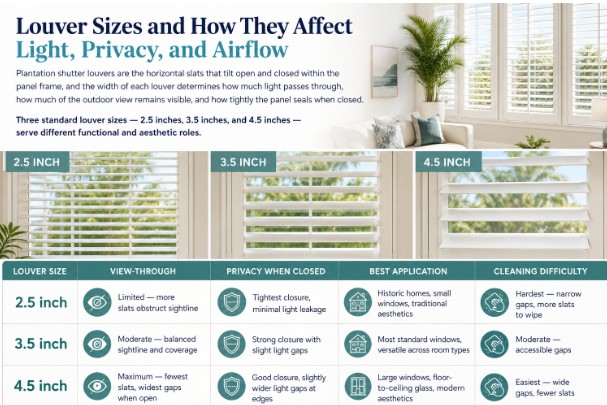
Plantation shutter louvers are the horizontal slats that tilt open and closed within the panel frame, and the width of each louver determines how much light passes through, how much of the outdoor view remains visible, and how tightly the panel seals when closed.
Three standard louver sizes — 2.5 inches, 3.5 inches, and 4.5 inches — serve different functional and aesthetic roles.
| Louver Size | View-Through | Privacy When Closed | Best Application | Cleaning Difficulty |
| 2.5 inch | Limited — more slats obstruct the sightline | Tightest closure, minimal light leakage | Historic homes, small windows, traditional aesthetics | Hardest — narrow gaps, more slats to wipe |
| 3.5 inch | Moderate — balanced sightline and coverage | Strong closure with slight light gaps | Most standard windows, versatile across room types | Moderate — accessible gaps |
| 4.5 inch | Maximum — fewest slats, widest gaps when open | Good closure, slightly wider light gaps at edges | Large windows, floor-to-ceiling glass, modern aesthetics | Easiest — wide gaps, fewer slats |
The 3.5-inch louver is the most widely specified size for installations across South Florida because it balances light control, privacy, and visual proportion on standard-height windows (36–60 inches).
Homeowners with large window openings — floor-to-ceiling impact sliders, oversized great-room glass, and golf-course- or waterway-facing walls — benefit from 4.5-inch louvers that let the shutters visually disappear when open, preserving the view that sold the home in the first place.
The 2.5-inch louver remains structurally necessary for windows with shallow frame depth (less than 2.5 inches from the glass to the trim face), where wider louvers cannot clear the glass surface when tilted.
Older Boca Raton homes built before 1990 frequently have these shallow frames, and forcing a 3.5-inch louver into a shallow recess results in louvers striking the glass when operated — a contact point that damages both the louver edge and any protective film on the glass.
Tilt mechanisms also affect daily operation. Traditional center-tilt rods connect all louvers to a single vertical control bar, producing the classic plantation aesthetic.
Hidden-tilt (rear-mounted gear-and-pinion) systems eliminate the visible rod for a cleaner panel face, which pairs particularly well with 4.5-inch louvers in contemporary interiors. Boca Blinds’ shutter gallery showcases both configurations in Boca Raton homes with varying window sizes.
What Plantation Shutters Cost in South Florida
Plantation shutter pricing in South Florida ranges from $20 to $45 per square foot of window coverage when professionally measured and installed. The total per-window cost depends on the material, louver size, window dimensions, and whether the window requires custom fabrication for arched, angled, or radius-top frames.
For a standard 36-by-60-inch double-hung window, homeowners in Palm Beach County can expect the following installed price ranges: hardwood at $250–$800, composite at $175–$650, PVC at $75–$400, and vinyl at $75–$200.
Specialty windows — bay configurations, sliding glass doors, and arched frames common in Mediterranean-style construction throughout Boca Raton, Delray Beach, and Parkland — increase the per-window cost by 20–40% due to custom-radius fabrication and additional installation labor.
Whole-home shutter projects covering 8–15 standard windows typically fall in the $1,500–$5,000 range for composite materials, with hardwood pushing the upper boundary toward $6,000–$8,000.
The installed price from Boca Blinds includes the free in-home measurement, custom fabrication, factory-trained installation labor, and full manufacturer warranty coverage — a scope that franchise competitors often unbundle into separate line items.
How Professional Measurement and In-House Installation Protect Your Investment
Every Boca Blinds plantation shutter project begins with a factory-trained installer measuring every window opening in the home — frame width, frame height, recess depth, and mounting surface condition.
This on-site assessment determines whether each window requires an inside mount (recessed into the frame) or an outside mount (overlapping the frame onto the wall), and whether the frame depth accommodates the selected louver size without glass contact.
Measurement errors are the single most common cause of shutter failure. A panel fabricated 1/8 inch too wide binds inside the frame and cracks under thermal expansion. A panel fabricated 1/4 inch too narrow leaves visible light gaps that eliminate both privacy and insulation value.
Boca Blinds’ in-house measurement-to-installation process — the same team that measures the window also installs the finished product — eliminates the communication breakdowns that occur when a franchise sends one crew to measure and another to install.
The in-house installation standard also protects warranty coverage. Hunter Douglas and other premium manufacturers require factory-certified installation to honor the full manufacturer warranty, not a reduced dealer-only warranty.
Boca Blinds has maintained continuous Hunter Douglas factory certification since 1976, which means every shutter installed qualifies for manufacturer-level warranty protection.
Homeowners considering the full purchase-to-installation process should verify that any installer they evaluate holds active manufacturer certification — not just a dealer agreement.
Maintaining Plantation Shutters in South Florida’s Coastal Climate
Plantation shutters require less routine maintenance than any other window treatment category, but South Florida’s salt air, humidity, and airborne particulate load mean that neglecting basic upkeep accelerates finish degradation on even the most durable materials.
A monthly wipe-down with a dry microfiber cloth removes dust buildup from louver surfaces. Quarterly cleaning with a lightly dampened cloth and mild detergent addresses salt film that accumulates on east-facing and ocean-facing installations.
Hardwood shutters require the most attentive maintenance schedule. Inspect hinge pins and tilt mechanisms every six months for corrosion, particularly in homes within two miles of the Intracoastal Waterway or the Atlantic coastline.
Composite and PVC shutters tolerate a less rigorous schedule because their non-porous surfaces resist salt absorption, but hinges and frame-mount hardware should still be checked annually and lubricated with a silicone-based spray to prevent binding.
Detailed guidance on cleaning and maintaining plantation shutters across all material types helps homeowners preserve the finish warranty and extend the functional life of every panel.
Homeowners interested in how shutters reduce energy costs in South Florida homes can layer maintenance practices with seasonal louver angle adjustments — tilting louvers upward during summer months deflects direct radiant heat toward the ceiling rather than the floor, reducing both surface temperature and cooling load.
For homeowners exploring additional configuration options, tier-on-tier plantation shutters allow independent operation of the upper and lower panels, providing privacy on the lower half while keeping the upper louvers open for airflow and natural light.
Tier-on-tier configurations are particularly effective in street-facing bedrooms and ground-floor living spaces throughout Boca Raton, where room-divider applications and top-rated shutter options further expand what a single shutter investment can accomplish.
Frequently Asked Questions
How long do plantation shutters last in South Florida’s humidity?
Composite and PVC plantation shutters installed by a factory-certified team have lasted 25–30 years in South Florida humidity without warping, yellowing, or joint failure. Hardwood shutters last 15–25 years when installed in low-humidity rooms and maintained with biannual hinge inspection and finish touch-ups as needed.
What material works best for plantation shutters in a bathroom or kitchen?
Composite or PVC materials perform best in bathrooms and kitchens because they resist moisture absorption, which causes real wood to swell and warp. PVC with an aluminum-reinforced core is the strongest option for shower-adjacent or pool-enclosure windows where direct water contact is unavoidable.
Are plantation shutters more energy-efficient than blinds or shades?
Plantation shutters create a denser insulation barrier than blinds or roller shades because the rigid panel-and-frame assembly traps a dead-air pocket between the shutter and the glass. That air pocket slows conductive heat transfer, reducing cooling load during South Florida’s extended summer months.
What louver size should I choose for large windows in South Florida?
The 4.5-inch louver provides maximum view-through on large windows, floor-to-ceiling sliders, and golf-course-facing glass walls. Fewer slats per panel mean less visual obstruction when open and easier cleaning. The 3.5-inch louver is ideal for standard windows where balanced light control matters more than panoramic sightlines.
Do plantation shutters increase home resale value in Palm Beach County?
Real estate professionals estimate that plantation shutters return approximately 75% of their installed cost at resale, outperforming every other window treatment category. Buyers in Boca Raton, Delray Beach, and Parkland recognize shutters as a permanent architectural upgrade, not a decorative accessory.
Can plantation shutters be installed on impact windows required by the Florida Building Code?
Plantation shutters mount on impact-rated windows when the installer calculates the correct standoff depth between the shutter panel and the glass surface. Factory-trained installers verify frame recess dimensions on-site to ensure shutter operation does not interfere with impact-glass performance.
How do I clean plantation shutters in a salt-air environment?
Monthly dry-dusting with a microfiber cloth removes surface particulate. Quarterly damp wiping with mild detergent removes the salt film that accumulates on east- and ocean-facing installations. Hinge hardware should be lubricated annually with a silicone spray to prevent corrosion-driven binding.
What is the difference between a hidden-tilt and a center-tilt rod on plantation shutters?
A center-tilt rod is a vertical bar that connects all louvers on the panel face, tilting them open or closed with a single motion. A hidden-tilt system uses a rear-mounted gear-and-pinion mechanism that eliminates the visible rod, producing a cleaner panel face that pairs with contemporary interiors and 4.5-inch louvers.
Your windows are either working with your air conditioning or against it — Boca Blinds has specified the right shutter material, louver size, and mounting configuration for South Florida exposures since 1976, so book your free in-home measurement and get a written quote before a single product is ordered.