

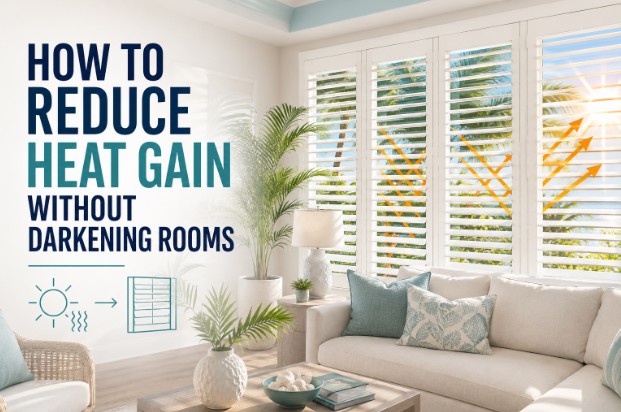
Solar shades are engineered mesh window coverings that block 65–90% of incoming solar heat while keeping rooms bright enough to work, cook, and entertain without turning on overhead lights.
Boca Blinds, a family-owned window treatment specialist operating in Boca Raton since 1976, installs custom solar shades sized to each window’s exposure, frame depth, and daily sun pattern — using in-house factory-trained technicians, never subcontractors.
The key to reducing heat gain without darkening a room is selecting the correct openness factor, fabric color, and mounting configuration for each window orientation in your home.
Key Takeaways
- Solar shades with a 3–5% openness factor block 90–97% of solar heat while preserving outward visibility and natural daylight — the optimal balance for most South Florida living spaces.
- Lighter-colored solar fabrics reflect more heat away from the glass, while darker fabrics absorb more heat but provide sharper glare reduction and clearer views to the outside.
- West-facing and south-facing windows generate the highest solar heat gain in Boca Raton homes and should be prioritized when budgeting a solar shade project.
Afternoon glare and rising FPL bills are signs your windows are working against your cooling system — Boca Blinds’ factory-trained team matches the right shade spec to your exact exposure, so schedule your free in-home measurement and get a written quote before any product is ordered.
What Makes Solar Shades Different From Blackout Shades and Blinds
Solar shades solve a problem that blackout shades and standard blinds cannot: they reduce heat without eliminating daylight. The difference comes down to fabric construction.
- Solar shades use a woven mesh with a measured openness factor (1–14%) that filters UV and infrared radiation while transmitting visible light. A 5% openness fabric blocks approximately 90% of solar heat while still letting you see the pool, landscaping, or the neighbor’s roofline.
- Blackout shades use opaque fabric that blocks 100% of light and heat — effective for bedrooms but impractical for kitchens, living rooms, and home offices where natural light is essential.
- Standard blinds redirect light by angling slats, but aluminum and vinyl slats conduct heat into the room rather than reflecting it at the glass surface. The U.S. Department of Energy notes that window coverings that reflect heat at the glass perform better than coverings that simply redirect light after it enters the room.
Homeowners who want a full breakdown of how different treatments perform in South Florida heat can review the complete cooling guide, which covers cellular shades, draperies, reflective blinds, and solar shades.
How the Openness Factor Controls Heat and Light
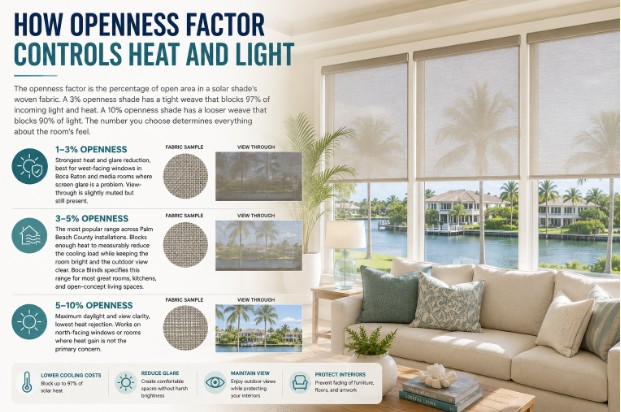
The openness factor is the percentage of open area in a solar shade’s woven fabric. A 3% openness shade has a tight weave that blocks 97% of incoming light and heat. A 10% openness shade has a looser weave that blocks 90% of light. The number you choose determines everything about the room’s feel.
- 1–3% openness — strongest heat and glare reduction, best for west-facing windows in Boca Raton and media rooms where screen glare is a problem. View-through is slightly muted but still present.
- 3–5% openness — the most popular range across Palm Beach County installations. Blocks enough heat to measurably reduce the cooling load while keeping the room bright and the outdoor view clear. Boca Blinds specifies this range for most great rooms, kitchens, and open-concept living spaces.
- 5–10% openness — maximum daylight and view clarity, lowest heat rejection. Works on north-facing windows or rooms where heat gain is not the primary concern.
| Decision Factor | 1–3% Openness | 3–5% Openness | 5–10% Openness |
| Heat reduction | Highest (blocks 94–97%) | Strong (blocks 90–95%) | Moderate (blocks 85–90%) |
| Glare control | Maximum | Strong | Moderate |
| Outward view clarity | Slightly muted | Clear | Sharpest |
| Best window orientation | West, south | All orientations | North, east |
| Daytime privacy | Strong | Moderate | Limited |
The 5% openness shade is the most versatile single specification — it balances light filtering, heat rejection, and view preservation for rooms that serve multiple purposes throughout the day.
Fabric Color and Why It Matters More Than Most Homeowners Expect
Fabric color affects solar shade performance independently of openness factor:
- Lighter fabrics (white, cream, linen) reflect more solar radiation back through the glass. A light-colored 3% shade keeps the room cooler than a dark-colored 3% shade because it bounces heat away rather than absorbing it into the fabric. Best for rooms where maximum heat reduction is the priority.
- Darker fabrics (charcoal, black, bronze) absorb more heat but reduce glare more aggressively and produce a sharper view-through to the outdoors. A dark 3% shade lets you see the backyard more clearly than a light 5% shade at the same window. Best for home offices, living rooms facing water or golf course views, and any room where screen glare interferes with daily use.
Boca Blinds carries solution-dyed solar fabrics rated for the UV intensity and humidity levels specific to South Florida’s climate.
Solution-dyed yarns hold color longer than surface-dyed alternatives because the pigment saturates the entire fiber rather than coating the exterior — a critical distinction in homes where fabrics face 3,000+ hours of annual sun exposure.
Where Solar Shades Deliver the Biggest Impact in Boca Raton Homes
Not every window in a South Florida home generates the same heat load. Prioritizing the highest-gain exposures first produces the largest comfort and energy improvement per dollar spent:
- West-facing windows — receive direct, low-angle afternoon sun from approximately 1:00 PM to sunset. This is the highest heat-gain orientation in any Boca Raton home and the exposure where solar shade selection produces the most measurable difference. Specify 1–3% openness with a darker fabric for optimal glare control.
- South-facing windows — receive consistent overhead sun throughout the day. A 3–5% openness shade handles this exposure well for most room types.
- East-facing windows — receive morning sun that is less intense than west exposure but still drives glare and furniture fading. A 5% openness shade preserves morning brightness while cutting UV.
- North-facing windows — receive the least direct sun. Solar shades are optional here unless privacy or diffused light control is needed.
Homeowners in Parkland and inland communities face open-sky western exposure without coastal cloud cover, making west-facing solar shades a higher priority than in oceanfront homes, which benefit from afternoon sea-breeze cloud patterns.
Boynton Beach gated communities with lake-view and golf-course-facing great rooms face the same west-exposure challenge across nearly every floor plan.
Manual, Motorized, and Double-Roller Options
Solar shades come in three operation configurations, each suited to different room conditions:
- Manual (cord or cordless) — lowest cost, starting at $60–$380 per window installed. Cordless lift systems eliminate dangling cords for child and pet safety. Best for standard-height windows that are easy to reach.
- Motorized — controlled by remote, wall switch, smartphone app, or smart-home integration (Alexa, Google Home). Starts at $160–$520 per window installed. Best for floor-to-ceiling glass, hard-to-reach transoms, and homeowners who want scheduled automation during peak sun hours. Budget-friendly motorized options now include battery-powered drives that require no wiring.
- Double-roller — pairs a solar shade with a blackout shade on a single headrail, providing daytime heat filtering and full nighttime privacy in a single unit. Double-roller shades are the most in-demand configuration for sunroom and master-bedroom applications across Palm Beach County.
Boca Blinds’ installation gallery showcases all three configurations in homes across Boca Raton, with varying window sizes and exposure conditions.
Every installation is performed by in-house factory-trained technicians carrying active Hunter Douglas certification — the requirement for manufacturer-level warranty coverage on every product installed.
What Solar Shades Cost in the Boca Raton Area
Pricing depends on window size, openness factor, fabric grade, and whether the shade is manual or motorized:
- Manual interior solar shades: $60–$380 per window installed
- Motorized interior solar shades: $160–$520 per window installed
- Double-roller systems (solar + blackout): $450–$1,100 per standard window installed
- Whole-home projects (8–15 windows, mixed configurations): $1,500–$6,000+
Solar shades may reduce cooling bills by 15–25% during South Florida’s 6-month summer cycle, with a typical payback period of 2–3 years in high-exposure homes.
The installed price from Boca Blinds includes the free in-home measurement, custom fabrication, and roller shade installation by factory-trained staff.
Your rooms should stay bright, cool, and protected — Boca Blinds has specified the right openness factor, fabric color, and mount configuration for South Florida exposures since 1976, so request your free in-home measurement and get a written quote on the spot.
Frequently Asked Questions
Do solar shades block heat without making rooms dark?
Solar shades with a 3–5% openness factor block 90–95% of solar heat while transmitting enough visible light to keep rooms naturally bright during daylight hours. The woven mesh filters UV and infrared radiation at the glass surface without eliminating the daylight that makes a room feel open and livable.
What openness factor works best for west-facing windows in Boca Raton?
West-facing windows receive the most intense afternoon sun in any South Florida home and perform best with a 1–3% openness solar shade paired with a darker fabric color. This combination delivers maximum heat rejection and glare control while still maintaining a visible connection to the outdoor view through the mesh.
Are motorized solar shades worth the extra cost over manual shades?
Motorized solar shades cost $100–$200 per window more than manual models but eliminate the daily effort of raising and lowering shades across multiple rooms. Scheduled automation lowers shades during peak sun hours and retracts them after direct exposure has passed, producing more consistent heat reduction than manual operation, which depends on the homeowner remembering to act.
How long do solar shades last in South Florida’s climate?
Solution-dyed solar shade fabrics rated for UV exposure typically last 7–10 years before the weave begins to lose structural integrity or color fidelity. Motorized lift mechanisms carry manufacturer warranties of 5–10 years depending on the brand. Boca Blinds’ factory-trained installation and active Hunter Douglas certification ensure full manufacturer warranty coverage on every component.
Can I combine solar shades with other window treatments for nighttime privacy?
Double-roller shade systems pair a solar shade with a blackout shade on a single headrail, providing filtered daylight during the day and full privacy after dark. This eliminates the need for separate curtains or blinds and keeps the window profile clean. Double-roller systems are the most popular layered configuration in South Florida master bedrooms and living rooms.