

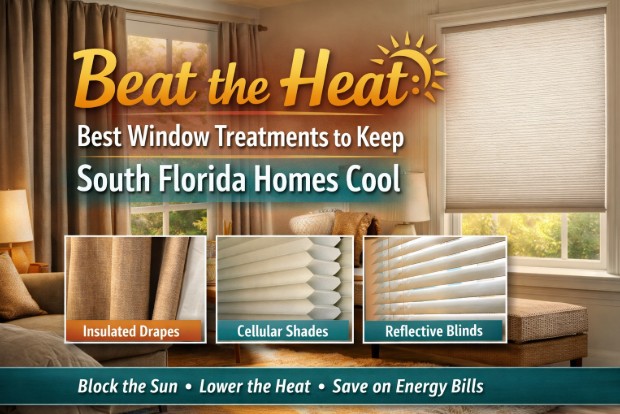
South Florida summer sun drives indoor heat gain through window glass. Solar heat gain forces air-conditioning systems to run longer, increasing energy use and reducing comfort.
Window treatments reduce solar heat gain by blocking direct sun, reflecting radiant heat, and adding an insulating air layer at the window.
The U.S. Department of Energy recommends closing covering overhangs, sunny exposures, and using light-colored coverings to reflect heat away from the home.
Quick Answer: Best Window Treatments to Beat Summer Heat
Window treatments reduce indoor heat by blocking direct sunlight on east-, west-, and south-facing windows during peak sun hours.
Insulated cellular shades, backed draperies, and reflective blinds deliver the strongest summer heat reduction when installed tightly and used consistently.
Best-performing options
- Insulated cellular (honeycomb) shades with a tight fit reduce unwanted solar heat through windows by up to 60% during cooling seasons. The Department of Energy’s Energy.gov
- Medium-colored draperies with white plastic backings reduce heat gain by about 33% on direct-sun windows, under DOE-cited guidance.
- Highly reflective blinds (fully closed and lowered) reduce heat gain by around 45% on a sunny window.
How Window Treatments Reduce Solar Heat Gain in South Florida Homes
Solar heat gain is heat that enters a home when sunlight passes through windows and warms interior surfaces.
Window treatments reduce solar heat gain through three mechanisms: reflection, blockage, and insulation.
Heat-control mechanisms that matter:
- Direct-sun blocking: Closed coverings stop sunlight from heating floors, furniture, and walls.
- Reflective surfaces: Light-colored, reflective materials reflect more radiant energy back toward the window.
- Tight-fit insulation: A snug installation reduces edge gaps and creates an air layer that slows heat transfer.
South Florida Window Exposure Playbook
Window orientation predicts summer heat gain patterns. East-facing windows spike in the morning. West-facing windows spike in the afternoon. South-facing windows receive sustained sun exposure in many homes.
Curtains and Drapes for Summer Heat Control: Backings, Fabrics, and Best Use
Curtains and drapes reduce indoor heat when kept closed on windows facing direct sunlight during peak heat hours.
Medium-colored draperies with white plastic backings can reduce heat gain by about 33% per DOE guidance.
Heat-control levers that produce measurable impact:
- Exposure targeting: Curtains and drapes perform best on east-, west-, and south-facing windows that receive direct sun.
- Reflective backing: White plastic backings increase reflectivity and reduce radiant heat transfer.
- Seal quality: Side and center gaps increase heat ingress, so a tighter closure improves performance.
Operational checklist (do this every hot day):
- Close curtains and drapes on windows facing direct sunlight during peak sun exposure.
- Choose a medium-color fabric paired with a white plastic backing for stronger summer heat reduction.
- Mount curtains close to the window to reduce airflow and heat transfer at the glass.
Window Shades That Keep Rooms Cooler: Tight-Fit Installation and Insulating Options
Window shades reduce heat most effectively when mounted close to the glass and kept drawn during direct sun.
A tight installation reduces edge gaps and strengthens the insulating air layer at the window.
Best shade types for summer heat control
- Cellular (honeycomb) shades: Cellular shades trap air in their structured cells, improving insulation at the window.
- Light-facing shade surfaces: Light-colored interior coverings reflect more heat than dark ones, reducing solar heat gain.
- Reversible shades: Reversible shades enable seasonal tuning, with a light-facing summer surface reflecting more sunlight.
Cellular shades: performance anchors
The U.S. Department of Energy states that tightly installed cellular shades can reduce unwanted solar heat through windows by up to 60% during cooling seasons. The Department of Energy’s Energy.gov A U.S. Department of Energy building technology fact sheet reports measurable energy savings from cellular shades relative to baseline scenarios in field-relevant testing. The Department of Energy’s Energy.gov
Reflective Blinds for Heat Reduction: Slat Angle Settings That Work
Blinds reduce summer heat by controlling solar exposure through slat angle and closure. Highly reflective blinds can reduce heat gain by approximately 45% when kept fully closed and lowered on a sunny window.
Heat-control settings that outperform “half-open” blinds:
- Fully closed + lowered: Fully closed reflective blinds reduce heat gain more than partially open slats on sunny exposures.
- Light-colored slats: Light-colored blinds reflect more sunlight than dark slats, which reduces solar heat gain.
- Ceiling-bounce daylighting: Horizontal slat blinds can redirect sunlight onto a light-colored ceiling, diffusing it with less glare.
Layering Strategy: Shade + Drapery Seal for Peak Sun Windows
Layering window treatments improves thermal performance by adding insulation and reducing air movement at the window.
A layered system pairs a tight-fit shade with a sealing drapery, so the window receives both insulation and radiant-heat blocking.
Best layering combinations for summer comfort:
- Cellular shade + lined drapery for maximum heat reduction on west-facing windows
- Solar/roller shade + drapery for glare control with a softer aesthetic
Drapery seal checklist (high impact, low complexity):
- Hang draperies close to windows to reduce air movement at the glass.
- Increase edge sealing with returns or side overlap where feasible to reduce heat entry.
Coastal Durability in South Florida: UV, Humidity, and Material Selection
The South Florida sun accelerates fading and heat stress on materials. South Florida’s humidity increases the risk of swelling and deformation for moisture-sensitive components. Material selection protects performance and appearance over time.
| Environmental stressor | Common failure mode | Better-performing material direction |
| High UV exposure | Fading, brittleness, warping | UV-stable finishes; light-facing surfaces |
| High humidity | Swelling, binding, surface damage | Moisture-tolerant materials in kitchens and baths |
| High-use operation | Mechanism wear | Durable lift/tilt hardware; stable mounting |
Daily Heat Routine: A Simple Schedule That Improves Results
A heat-control plan works best when window coverings follow the sun’s path, not room names.
Morning (east-facing sun):
- Close coverings on east-facing windows when direct sun hits the glass.
Midday (south-facing intensity):
- Close coverings on south-facing windows during peak sun exposure.
- Use north-facing windows for daylight when they avoid direct sun.
Afternoon (west-facing peak heat):
- Close coverings on west-facing windows before peak afternoon sun.
Evening (cooldown):
- Open coverings after direct sun passes to restore daylight and views.
This schedule reduces solar heat gain when it spikes.
Heat-Control Decision Tree: Choose the Right Treatment Fast
- Choose cellular shades with a tight fit when maximum cooling performance matters most.
- Choose draperies with white-backed linings when a soft-treatment look is required to reduce heat gain.
- Choose highly reflective blinds when adjustable daylight and glare control must coexist with heat reduction.
- Choose layering (shade + drape) when west-facing windows create persistent afternoon heat.
Frequently Asked Questions
How do window treatments reduce indoor heat?
Window treatments reduce indoor heat by blocking direct sun and lowering solar heat gain through window glass. Tight-fit shades add an insulating air layer, and reflective blinds and light-colored coverings reflect radiant heat away from living spaces.
Which window treatment is best for energy savings in summer?
Cellular shades are insulated shades that trap air in honeycomb cells. The U.S. Department of Energy reports that tightly installed cellular shades can reduce unwanted solar heat through windows by up to 60% in cooling seasons.
Do solar shades help keep a home cool?
Solar shades are roller shades that reduce glare and solar heat gain while preserving daytime visibility. Solar shades reduce heat gain by intercepting sunlight at the window, especially on west-facing glass that receives intense afternoon sun.
Can blinds improve comfort without blocking all light?
Blinds improve comfort by changing the slat angle to redirect daylight and reduce direct glare. The U.S. Department of Energy notes that horizontal slat blinds can bounce light onto a light-colored ceiling, diffusing daylight with less glare.
Are certain window treatments better suited to coastal climates?
Coastal climates stress window treatments through UV exposure and humidity. UV-stable finishes, moisture-tolerant materials, and durable lift mechanisms help maintain performance over time, so South Florida homes benefit from materials designed for sun and humidity exposure.
What role does window treatment layering play in heat reduction?
Layering combines insulation and radiant blocking in one window system. A tight-fit shade reduces heat transfer at the glass, and a lined drapery reduces radiant heat and improves edge sealing, which strengthens summer heat control on sunny exposures.
How much can reflective blinds reduce heat gain?
Highly reflective blinds can reduce heat gain by approximately 45% when kept fully closed and lowered on a sunny window. Consistent closure during direct sun exposure yields results that are more than partially open slats or intermittent use.
Get a Heat-Control Plan for Your Windows
A heat-control window treatment plan matches product type to window exposure, room function, and daily operating habits. Strategic daily opening and closing improves performance because static, always-open coverings allow direct sun to drive heat gain.
Call 561-368-5322 to schedule a free in-home estimate and confirm the best heat-control option for each window in a South Florida home.