

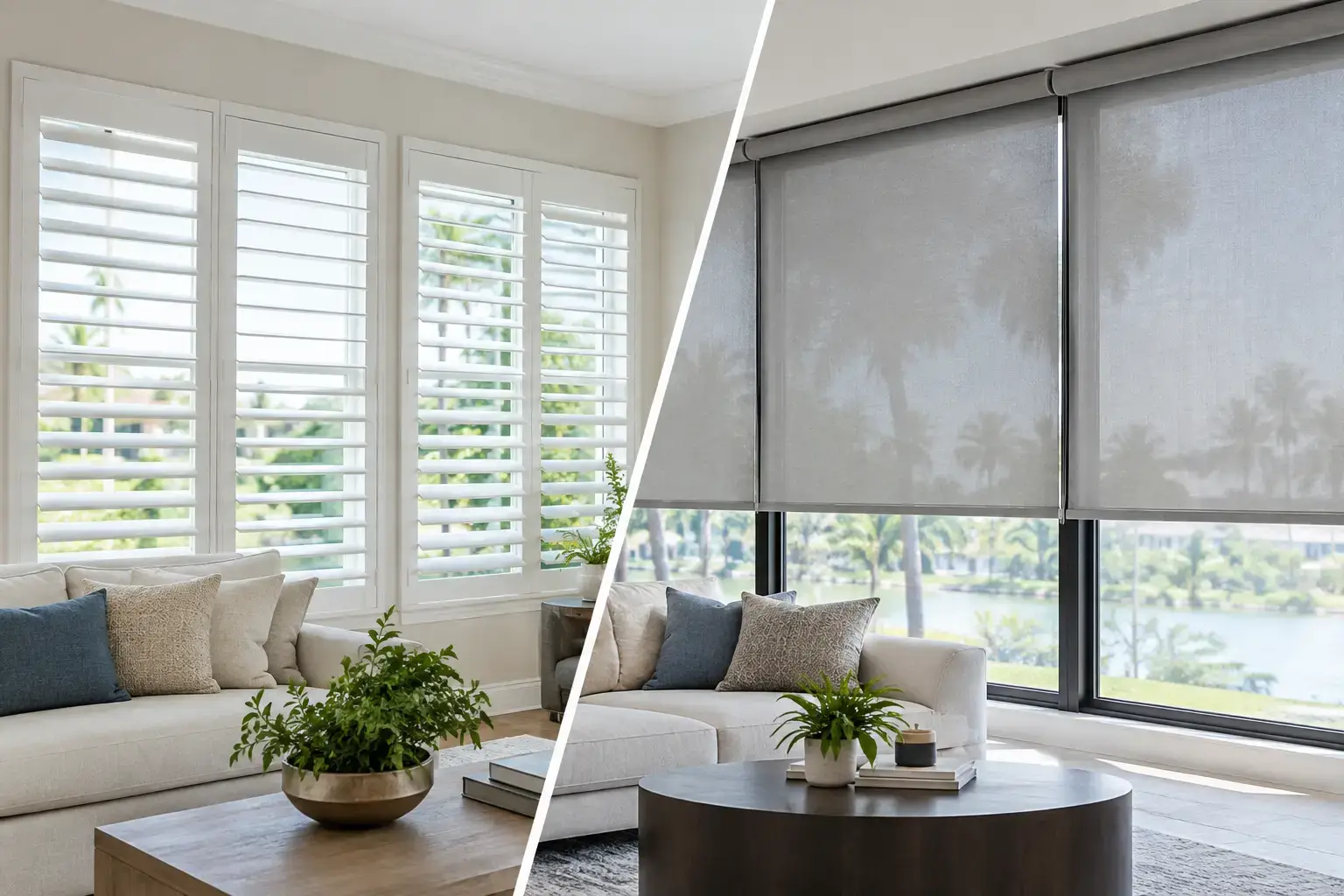
A beautiful window treatment should not force you to choose between sunlight and feeling comfortable in your own home. In South Florida, where close-set homes, bright afternoons, and active outdoor living are common, shutters versus blinds for privacy is a practical decision as much as a design one. Both can protect your space from outside views, but they do it differently – and the best fit depends on the room, the window, and how you live.
A front-facing living room may need adjustable privacy without making the space feel closed in. A bathroom may call for near-complete coverage and materials that tolerate humidity. In a bedroom, the ability to block sightlines at night can matter just as much as controlling early morning light. Understanding where shutters and blinds differ makes the choice much clearer.
Shutters Versus Blinds for Privacy: The Main Difference
Plantation shutters are fitted directly to the window frame and feature adjustable louvers within a solid panel. When the louvers are tilted, they can direct light upward or downward while limiting the view into the room. When fully closed, the shutter panels create a more structured barrier across the window.
Blinds use individual slats, often aluminum, faux wood, or wood, that raise, lower, and tilt. They also provide adjustable privacy, but the coverage depends more heavily on the slat position, the fit of the blind, and the space around the sides of the window. A well-measured custom blind can offer excellent privacy, yet it will not have quite the same frame-to-frame presence as a shutter.
The difference is not simply that one option is private and the other is not. It is about the degree of coverage, the kind of light you want to preserve, and whether you prefer a built-in architectural look or a lighter, more flexible window treatment.
When Shutters Are the Better Privacy Choice
For homeowners who want dependable privacy throughout the day, shutters are often the stronger option. Their custom frame and panel construction minimize the visible gaps that can occur around less tailored window treatments. This is especially valuable for windows facing a neighboring property, a sidewalk, a pool area, or a busy street.
Directed light without an open view
One of the best features of plantation shutters is the ability to angle louvers while keeping the window covered. For example, louvers can be tilted upward to bring in daylight while directing the line of sight toward the ceiling rather than into the room. That can make a living room or home office feel bright without putting the interior on display.
In rooms where privacy needs change throughout the day, a split-tilt configuration can be particularly useful. The lower section can remain closed for privacy while the upper louvers stay open to admit daylight. This approach works beautifully in street-facing rooms and spaces with low neighboring sightlines.
A polished fit for large or prominent windows
Shutters have a substantial, tailored appearance that suits formal living areas, primary bedrooms, dining rooms, and homes with a coastal, transitional, or classic interior style. They become part of the room’s architecture rather than reading as an accessory.
They are also a sensible consideration for South Florida homes because quality faux wood shutters resist moisture better than many natural wood products. In bathrooms, laundry rooms, and humid spaces near the coast, that durability can be as meaningful as the privacy itself.
Consider the trade-offs
Shutters are not always the right answer. Their panels need clearance to open fully, which can affect furniture placement near the window. They also have a more permanent visual weight than blinds, and their louvers must be cleaned individually. For homeowners who want a minimal profile or frequently need an entirely unobstructed window, another treatment may feel more suitable.
When Blinds Make More Sense for Privacy
Blinds are an excellent choice when you want privacy control in a streamlined, versatile format. Faux wood blinds, in particular, offer the familiar look of painted wood with a durable finish that performs well in warm, humid environments. Their tilt function lets you adjust visibility and light with a simple movement.
Everyday control in bedrooms and offices
In a bedroom, blinds can be tilted closed at night to reduce views from outdoors, then opened or raised in the morning for a clear view. In offices, they give occupants quick control over glare and visibility during the workday without changing the room’s overall appearance.
Blinds may also be easier to coordinate with other layers, such as draperies or decorative side panels. If you like softness around the window but still want adjustable privacy, blinds can form the functional layer beneath fabric treatments.
A lighter look for smaller spaces
Because blinds sit close to the glass and stack upward when raised, they can feel less visually dominant than shutters. This is helpful in smaller rooms, on windows with limited surrounding wall space, or in homes where the goal is a clean, understated finish.
The key is precise measurement and installation. Privacy can be reduced when blinds are too narrow, mounted in a way that leaves wide side gaps, or paired with slat sizes that do not suit the window. Custom-fitted blinds address these details so the treatment looks intentional and performs as expected.
Where blinds may fall short
Even fully lowered blinds usually have small openings between slats or along the sides, depending on the product and installation. At night, when interior lights are on, those small openings can become more noticeable from outside. If your priority is the most complete visual barrier possible, especially on a ground-floor window, shutters may offer greater peace of mind.
Privacy Changes by Room and Window Location
The most successful choice often varies from one room to the next. There is no need for every window in a home to have the same treatment if each space has a different purpose.
For bathrooms, consider moisture-resistant shutters or faux wood blinds with a close, custom fit. For bedrooms, think about nighttime privacy first, then decide whether additional room-darkening support is needed. For living rooms, adjustable louvers or slats can preserve daylight while reducing direct views from the street or neighboring homes.
Sliding glass doors and large patio openings require a different conversation. Vertical treatments, panel-style options, or coordinated solutions may provide better access and coverage than standard horizontal blinds or hinged shutter panels. A professional consultation is useful here because door operation, stacking space, and exterior views all affect the final design.
Upper-floor windows also deserve attention. A window may feel private during the day but become exposed after dark when indoor lighting creates a clear view from outside. Test the room at the time privacy matters most before selecting a treatment.
Light, View, and Privacy Must Work Together
Privacy is rarely the only goal. South Florida homeowners often want to soften intense sun, protect furnishings from harsh light, and maintain the views that make their homes special. The right window treatment balances those priorities rather than solving one problem at the expense of the others.
Shutters generally offer a more architectural approach to this balance. Their louvers can filter light attractively, and their panels can be opened for a full view when desired. Blinds offer fast, familiar adjustment and can disappear upward when you want the glass completely uncovered.
If privacy is your top priority but you do not want the room to feel dark, focus on adjustability. Treatments that tilt, rather than simply open or close, give you more control over the relationship between light and visibility.
Choose Based on the Finished Room, Not the Sample
A small sample can show color and material, but it cannot reveal how a treatment will affect sightlines from outdoors, furniture clearance, or the character of the finished room. That is why an in-home assessment is so valuable. It allows the design to account for window depth, mounting options, daylight direction, and how each room is used.
Boca Blinds has helped South Florida homeowners make these decisions since 1976, with personalized design guidance and professional installation for custom window treatments. Whether shutters or blinds better suit your privacy needs, the goal is the same: a solution that feels beautiful from inside the home and comfortably private when the sun goes down.
Before making a final selection, stand outside the window at different times of day and consider what you can see. That simple step often points you toward the treatment that will make the room feel truly your own.