

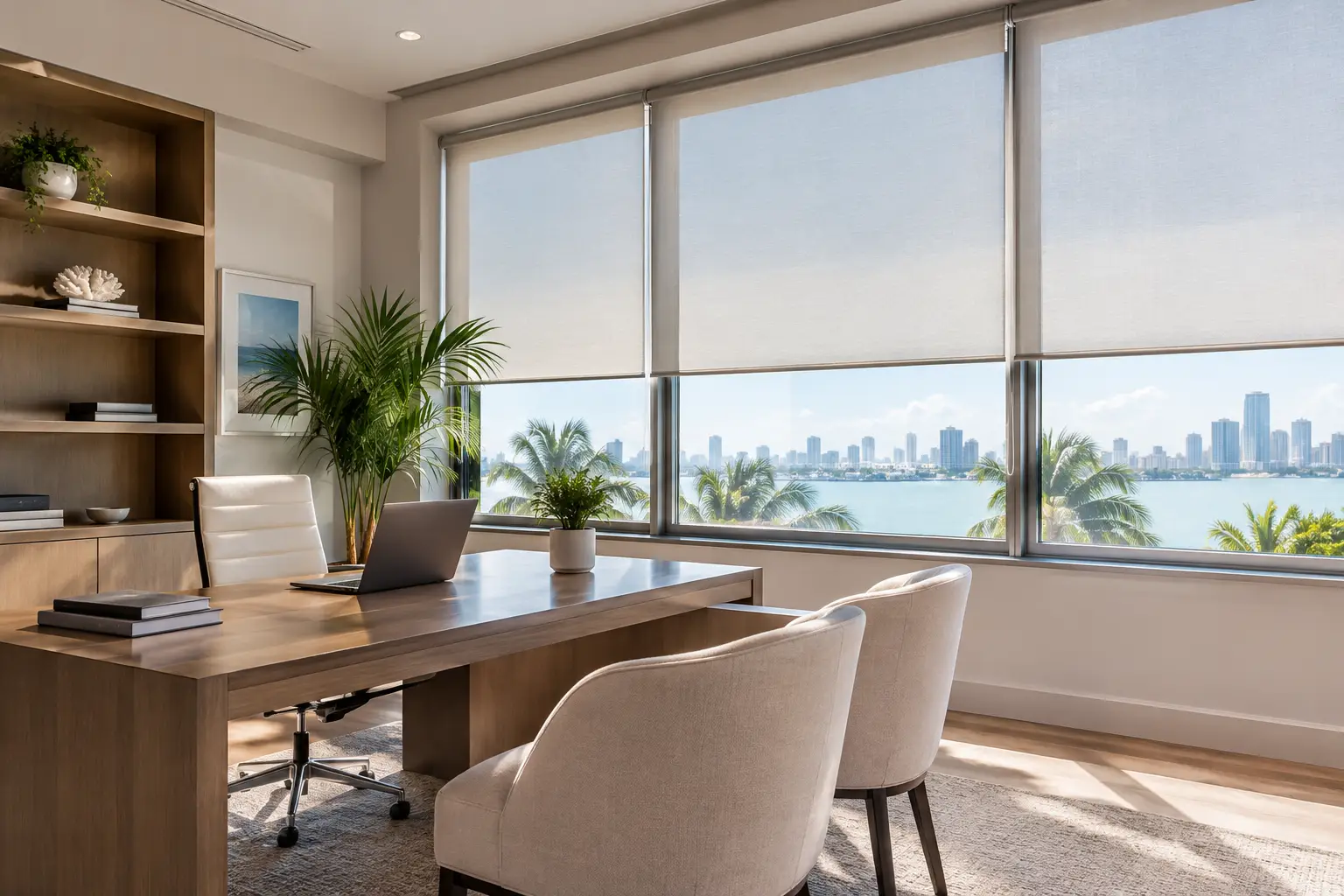
A west-facing conference room can turn a productive afternoon into a battle with screen glare, heat, and squinting employees. The right window treatment solves those issues without making the office feel closed in. This office window blinds guide helps business owners, property managers, and professionals choose coverings that support comfort, privacy, presentation, and the daily demands of a South Florida workspace.
Start With What the Office Needs to Do
Office blinds are not a one-size-fits-all purchase. A private medical practice, a law office, a coworking suite, and a corporate reception area may all need different levels of light control and privacy. Before choosing a material or color, consider what happens in each room throughout the day.
Reception areas often benefit from a clean, tailored treatment that filters harsh sunlight while preserving an inviting street-facing appearance. Individual offices may require adjustable privacy for meetings and video calls. Conference rooms need reliable glare reduction for monitors and presentations, while break rooms can usually accommodate a more relaxed decorative choice.
Sun exposure matters just as much as the room’s purpose. In Boca Raton and nearby coastal communities, intense sun can create hot spots near windows, fade furnishings, and make computer work uncomfortable. A treatment that looks beautiful in a showroom may not perform well on a large west- or south-facing wall of glass unless it is selected with solar control in mind.
It also helps to decide whether the covering will be adjusted frequently. If employees need to raise, lower, or tilt blinds several times a day, ease of operation should be a priority. If the treatment will remain in roughly the same position most of the time, a simpler shade may be the better fit.
Choose Light Control Before Style
The polished look of a window treatment matters, but its ability to manage light should lead the decision. The goal is rarely to block every ray of daylight. Natural light can make an office feel more open and pleasant. The challenge is controlling direct sun and reflections without sacrificing the view or creating a dark, enclosed atmosphere.
Solar Shades for Views and Screen Glare
Solar shades are a strong choice for offices with expansive windows, exterior views, and heavy computer use. Their specialized fabrics reduce glare and help soften heat from direct sunlight while maintaining a degree of outward visibility during the day. They have a streamlined profile that suits contemporary professional interiors and are especially effective in reception areas, executive offices, and conference rooms.
The openness of the fabric affects the result. A more open weave preserves more of the view but allows more light through. A tighter weave provides greater glare control and privacy but can make the window appear more covered. This is a detail best evaluated against the actual orientation and conditions of the office.
Roller Shades for a Clean, Flexible Finish
Roller shades offer a similarly uncluttered appearance with a broad range of fabrics, colors, and opacity levels. They can be selected for light filtering, room darkening, or a balance between the two. For offices where the shade will be raised fully during low-sun hours and lowered for presentations or afternoon comfort, their simple operation is a practical advantage.
A light-filtering roller shade works well where soft daylight is welcome. A more opaque fabric can be useful for a training room or conference space that occasionally needs stronger visual control. The trade-off is that greater opacity generally means less view-through when the shade is lowered.
Horizontal Blinds for Adjustable Directional Light
Horizontal blinds, including durable faux wood blinds, provide precise adjustment through their tilting slats. Rather than fully raising the treatment, users can redirect light upward, limit direct glare, or close the slats for privacy. This flexibility makes them a sensible option for private offices, administrative spaces, and rooms where the sun changes noticeably throughout the day.
Faux wood is particularly well suited to South Florida conditions. It delivers the tailored appearance of wood while standing up well to humidity and everyday cleaning. For a more traditional office or a professional suite with warm finishes, its structured look can add visual weight without appearing overly formal.
Privacy Is Different From Light Blocking
Many office clients assume a darker shade automatically provides privacy. In reality, privacy needs vary by time of day, window placement, and the activity inside the room. A front-facing office may need daytime screening from passersby, while an interior conference room may need full visual privacy during sensitive conversations.
Solar fabrics can provide excellent daytime glare control, but they are not always the answer for nighttime privacy when interior lights are on. Roller shades in an appropriate opacity, horizontal blinds with adjustable slats, or layered window treatments may be better suited to spaces that require more consistent privacy.
Consider sightlines, not just the window itself. Can visitors in the lobby see into an office? Does a neighboring building look directly into a conference room? Are patient, client, employee, or financial conversations taking place near the glass? These practical questions help determine whether the treatment should filter, obscure, or fully block the view.
Match Materials to a Commercial Environment
An office window treatment should retain its appearance under regular use. That means thinking beyond color swatches. Fabrics should coordinate with the furnishings and architectural finishes, but they should also be appropriate for the room’s traffic, cleaning needs, and sun exposure.
Neutral tones are popular in professional environments because they complement changing furniture and branding over time. White, soft gray, sand, and warm taupe can brighten the room without competing with artwork, flooring, or signage. Darker shades may be striking in an executive office or media room, but they can feel heavier in a compact space and may absorb more heat at the window.
For a design-forward setting, woven wood shades or soft sheers can introduce texture and warmth. These treatments can work beautifully in boutique offices, design studios, and client-facing areas where atmosphere is part of the experience. They are less likely to be the first choice for spaces requiring maximum glare reduction or frequent full privacy, which is why room-by-room planning is so valuable.
Durability also affects the long-term impression of the office. Treatments that warp, discolor, or operate poorly can make an otherwise polished workspace feel neglected. Custom sizing, quality hardware, and professional installation help blinds and shades hang evenly and operate as intended.
Consider Motorization for Large or Hard-to-Reach Windows
Motorized window coverings are not only for luxury homes. In an office, they can make daily light management more consistent and convenient. A single control can adjust several shades in a conference room before a presentation, lower coverings on a sun-exposed wall during the hottest hours, or raise them at the start of the workday.
Motorization is especially useful for tall windows, wide spans, and windows behind desks or conference tables. It also reduces the temptation to leave difficult-to-reach shades in one position all day, even when the changing sun calls for an adjustment. For an office with a refined, modern design, the absence of visible cords also contributes to a cleaner finish.
The right system depends on the number of windows, how independently they need to operate, and whether scheduled adjustments would be helpful. A professional consultation can clarify which rooms truly benefit from motorization and which are better served by manual operation.
Do Not Treat Measurement and Installation as an Afterthought
Office windows are often larger, less uniform, and more complicated than they first appear. Trim depth, window handles, door clearance, mullions, ceiling height, and furniture placement all affect how a blind or shade should be specified. Even a well-made product can underperform if it is measured incorrectly or installed without consideration for how the room functions.
Professional installation is particularly valuable for wide shades, multiple adjacent windows, motorized systems, and treatments mounted high above the floor. The finished result should look aligned from across the room, operate smoothly, and allow staff to use the window coverings without disrupting the workspace.
Boca Blinds brings decades of custom window treatment experience to office projects throughout South Florida, helping clients compare practical options in the actual light and layout of their space. Seeing materials in the office makes it easier to judge glare, privacy, color, and the final visual effect.
A Better Office Starts at the Window
The best office blinds do more than cover glass. They help people work comfortably, protect interior finishes, create appropriate privacy, and give clients a confident first impression. Begin with the room’s sunlight and daily use, then choose the style and operating system that supports both. A thoughtful, custom-fitted treatment can make the office feel finished every time the sun moves across the room.