

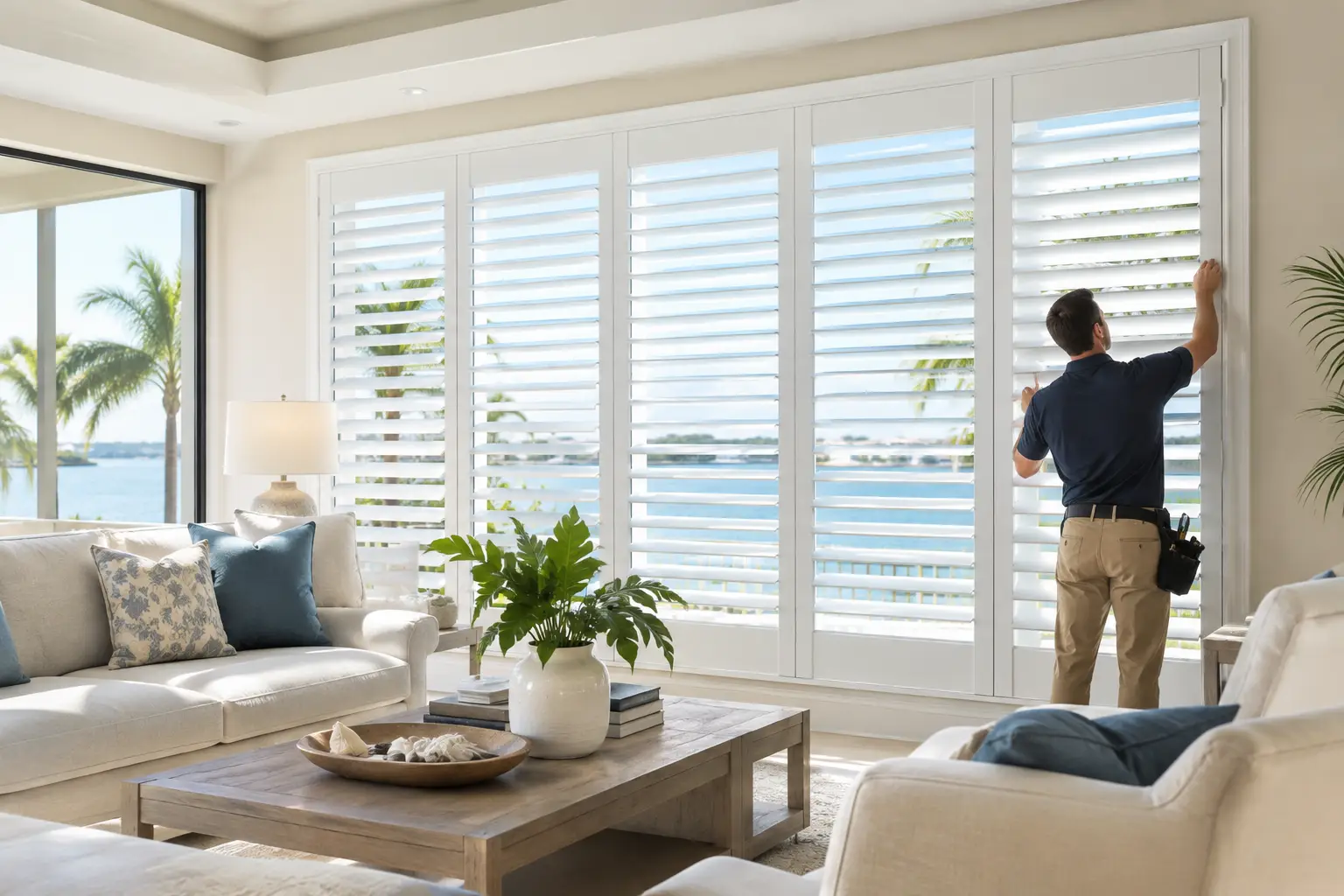
A blind that sits slightly crooked, leaves a gap at the edge, or catches on a window handle can change the feel of an otherwise beautiful room. This guide to professional blind installation explains why the work behind a polished window treatment matters just as much as the fabric, finish, or color selected for the window.
For South Florida homeowners, proper installation also has practical consequences. Strong sun, afternoon glare, privacy needs, large openings, and sliding glass doors all ask more of a window covering. Professional service helps ensure that custom blinds operate smoothly, look intentional, and provide the light control you chose them for.
Why Professional Blind Installation Is Different
Blinds may appear straightforward from across the room, but a finished installation depends on several precise decisions. The installer must confirm the correct mounting location, account for trim and window depth, find secure mounting points, level the headrail, and test the treatment through its full range of operation. Those details are especially noticeable with wide windows, tall windows, doors, and rooms where several treatments need to align.
Custom-fit blinds are measured for a particular opening, not simply selected from a standard size. A small measuring error can lead to side gaps, interference with window hardware, or a treatment that does not raise and lower properly. With inside-mounted blinds, the available depth and variations in the window frame must be considered. With outside mounts, the treatment must cover the opening attractively while respecting molding, walls, and nearby furniture.
Professional installation also protects the product. Brackets that are not anchored correctly can loosen over time, particularly with larger or heavier treatments. Improperly handled shades can be damaged before they are ever used. An experienced installer knows how the hardware is designed to function and how to make appropriate adjustments without compromising the finished appearance.
What Happens Before Installation Day
A successful project begins well before the installer arrives with brackets and tools. The consultation is the time to match a window treatment to how the room is used. A bedroom may call for stronger privacy and room-darkening capability, while a living area overlooking the water may benefit from solar shades that soften glare while preserving a view.
Measurements are then taken with the selected product in mind. This is critical because roller shades, cellular shades, faux wood blinds, woven woods, and plantation shutters each have different clearances, stacking dimensions, and mounting requirements. The same window can require a different approach depending on the treatment selected.
During this stage, a professional will also identify details that can affect the final result, such as:
- Window cranks, locks, and handles that project into the opening
- Shallow frames that may not support an inside mount
- Doors that need clearance to open freely
- Uneven walls or trim that require careful alignment
- Large spans that need properly placed support brackets
These are not minor technicalities. They are often the difference between a treatment that feels integrated into the room and one that feels like an afterthought.
The Professional Blind Installation Process
On installation day, the first step is confirming the order against the windows. Each blind or shade is matched to its designated location, and the installer checks that the mounting surface is suitable. This is particularly valuable in homes with similar-sized windows, where a treatment placed in the wrong opening may look close enough at first but fail to fit or operate as intended.
Next, the installer marks the mounting points and secures the brackets. Level placement is essential. Even a slight tilt can be obvious when a blind is lowered against a rectangular window frame. Proper bracket placement also distributes weight correctly, helping the headrail remain stable during everyday use.
Once the treatment is mounted, the work is not finished. The installer tests lifting, lowering, tilting, and any control features. For motorized window coverings, this includes confirming operation, programming limits when needed, and making sure the treatment responds reliably. The controls should be convenient for the homeowner, not merely functional.
Final adjustments bring the project together. The installer checks for even spacing, proper vane or slat movement, clean fabric rolls, and any contact with window hardware. They can also explain the correct operation and care of the product so that homeowners feel comfortable using it from the first day.
Inside Mount or Outside Mount: The Right Choice Depends on the Window
Inside-mounted blinds fit within the window opening, creating a tailored, built-in appearance. They are a popular choice when the window has sufficient depth and attractive trim that homeowners want to keep visible. This approach can look especially clean with cellular shades, roller shades, and horizontal blinds.
Outside-mounted treatments are installed on the wall or molding above and around the opening. They can provide more complete coverage, help minimize light gaps, and offer a solution for shallow or uneven window frames. Outside mounting is often useful when privacy or room darkening is the priority, or when a window has handles or cranks that make an inside mount impractical.
Neither option is universally better. The right choice depends on the window construction, the product, the desired light control, and the overall design of the room. This is where in-home guidance prevents an attractive idea from becoming an awkward fit.
Consider How South Florida Light Affects the Installation
In Boca Raton and surrounding communities, window treatments do more than decorate. Intense sun can create glare on screens, fade furnishings, and make certain rooms less comfortable during parts of the day. A properly installed solar shade, for example, needs to sit at the correct height and coverage area to manage light effectively without creating unnecessary gaps.
Large glass doors and expansive windows deserve particular attention. Wide blinds and shades require secure support and accurate leveling so they do not sag, bind, or look uneven. Treatments on doors must also be positioned to allow practical access. For a home office, living room, or bedroom, the installer should account for how people move through the space rather than treating every opening exactly the same.
Motorization can be especially useful for hard-to-reach windows, high ceilings, or rooms with several treatments that are used throughout the day. It is a convenience feature, but it is also a way to make light management easier and more consistent. Proper setup makes that convenience feel natural instead of complicated.
Why DIY Installation Can Create Lasting Frustration
Some homeowners are comfortable with smaller household projects, and a basic ready-made blind may seem manageable. The trade-off is that installation mistakes are often difficult to hide or correct once holes have been drilled and hardware has been mounted. A treatment may be level but positioned too low, secure but off-center, or technically installed yet unable to clear a door or window crank.
Custom treatments raise the stakes because they are designed around exact measurements and finishes. Professional installation helps preserve the value of that customization. It also removes the uncertainty of selecting hardware, locating secure mounting surfaces, and troubleshooting a treatment that does not operate as expected.
For offices, the need for professional work can be even clearer. Window coverings must look consistent across multiple openings, function reliably for employees and guests, and support the desired balance of daylight, privacy, and glare control. A careful installation supports the polished environment a business wants to present.
A Better Finish for the Windows You See Every Day
The best blind installation is easy to overlook because everything works as it should. The treatment sits straight, moves smoothly, complements the room, and delivers the privacy and light control the space needs. That quiet precision is the result of knowledgeable measuring, thoughtful product selection, and skilled installation.
Boca Blinds has helped homeowners and businesses create those finished spaces since 1976, with personalized design guidance and professional installation for custom window treatments. A free in-home estimate gives you the opportunity to see what fits your windows, your style, and the way you live before making a decision.
When your windows deserve more than a quick fix, choosing experienced installation lets the finished treatment look as good on day one as it should for years to come.