

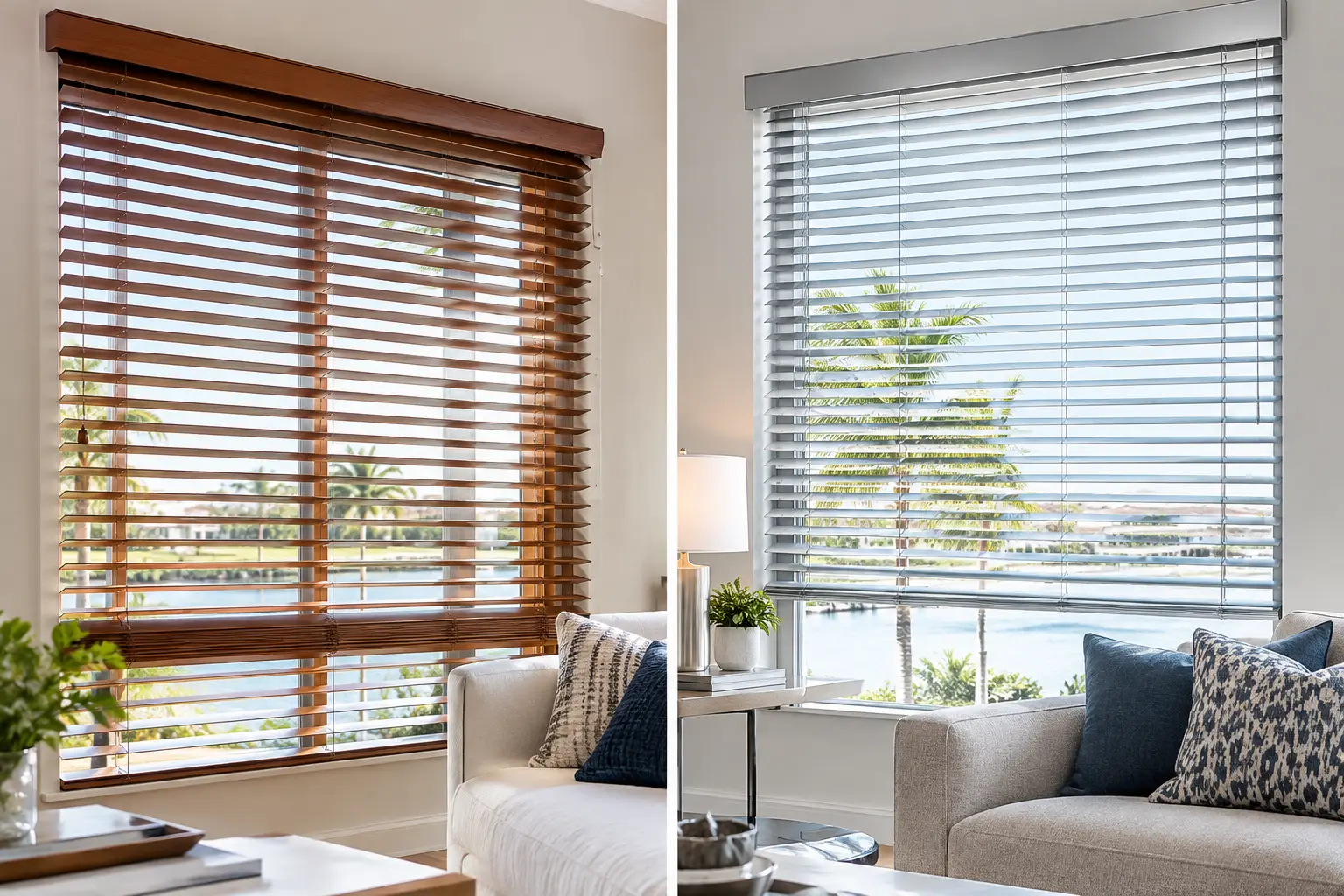
The right blind can change how a room feels at 3 p.m., when South Florida sun is strongest and privacy matters most. In the choice between faux wood blinds vs aluminum blinds, both offer adjustable light control and a clean, tailored appearance, but they perform very differently in humid rooms, high-traffic spaces, and design-forward interiors.
For many homeowners, the decision comes down to more than color. It is about how the blinds will hold up near salt air, how easily they clean, whether they coordinate with existing furnishings, and how much privacy they provide when closed. Understanding those everyday differences makes it easier to choose a window treatment you will appreciate for years.
Faux Wood Blinds vs Aluminum Blinds at a Glance
Faux wood blinds are made to create the warmth and visual substance of painted or stained wood while offering better resistance to moisture than natural wood. Their wider slats and more substantial profile make them a natural fit for living rooms, bedrooms, dining rooms, and many kitchens. They are especially popular in homes with plantation-style shutters, wood furnishings, or neutral coastal interiors.
Aluminum blinds use lightweight metal slats, usually in a narrower profile. They are practical, compact, and highly resistant to moisture. Their streamlined look works well in offices, laundry rooms, utility areas, bathrooms, and contemporary spaces where a lighter visual footprint is preferred.
Neither material is automatically better. A beautiful choice for a formal great room may not be the best choice for a sunny bathroom or a busy home office. The most successful selections account for the room, the window size, the desired view, and the surrounding design.
Style and Presence in the Room
Faux wood blinds have a warmer, more furniture-like quality. Their slats are commonly available in white, soft neutrals, and wood-inspired finishes, allowing them to blend with trim, cabinetry, flooring, and other architectural details. On larger windows, the wider slats can feel intentional and refined rather than visually busy.
They also work well when homeowners want a consistent, elevated look across several rooms. White faux wood blinds, for example, can complement traditional, transitional, coastal, and contemporary interiors without competing with the rest of the décor.
Aluminum blinds create a different impression. Their slimmer slats can look crisp and understated, particularly in modern offices or rooms where you do not want the window treatment to become a major decorative feature. They are available in a broad range of colors and finishes, but their appearance is generally more utilitarian than faux wood.
If the window treatment is meant to contribute warmth and polish, faux wood is often the stronger design choice. If the priority is a neat, low-profile blind with a practical feel, aluminum can be exactly right.
Humidity, Moisture, and South Florida Conditions
Moisture resistance is one of the most important considerations for homes in Boca Raton, Delray Beach, Boynton Beach, and nearby coastal communities. Humidity, frequent air conditioning cycles, open windows, and moisture-prone rooms can all affect window coverings over time.
Faux wood blinds are well suited for humid environments because they do not absorb moisture the way natural wood can. This makes them a dependable option for bathrooms, kitchens, and laundry rooms when a homeowner wants the appearance of a wider, more decorative slat. Quality matters here: a custom-fit product and professional installation help ensure the blind operates properly and sits neatly within the window opening.
Aluminum blinds are also highly moisture resistant. Metal slats will not warp from humidity, making them a sensible choice for bathrooms, garage-adjacent spaces, and commercial settings. However, aluminum can bend if handled roughly, especially in windows that are opened and closed frequently by children, guests, or employees.
For a humid room where appearance carries equal weight with performance, faux wood often has the advantage. For a purely functional moisture-resistant solution, aluminum remains a reliable contender.
Light Control, Privacy, and View Management
Both styles use adjustable slats, so each can direct sunlight upward, downward, or away from a seating area. This flexibility is valuable in South Florida homes, where strong afternoon sun can create glare on televisions, computer screens, and polished floors.
Faux wood blinds usually have wider slats, which can provide a more open view when tilted up and a more substantial barrier when closed. Their solid construction can help create a pleasing sense of privacy in bedrooms, street-facing rooms, and spaces close to neighboring homes. Keep in mind, though, that standard blinds have route holes and slat gaps. They are excellent for everyday privacy, but they do not create complete blackout conditions on their own.
Aluminum blinds offer precise light adjustment because of their narrower slats. They can be useful for fine-tuning glare in a home office or office suite. Yet their slimmer slats may allow a slightly more segmented look across the window when closed, and they can rattle or shift more noticeably in breezy areas.
For bedrooms that need deeper darkness, a blind may be paired with drapery panels or another compatible layering solution. For rooms where daylight control is the main goal, both materials can perform well when properly measured and fitted.
Durability and Everyday Care
Faux wood blinds are built for daily use and are generally easy to maintain. A light dusting, microfiber cloth, or gentle wipe with a damp cloth is usually enough to keep them looking fresh. Their sturdier slats are less likely to dent than aluminum, which is helpful in family rooms, breakfast areas, and homes with active children or pets.
Because faux wood blinds are heavier, very wide windows require careful product selection and installation. The lift system, valance, mounting surface, and window dimensions all deserve attention. A professional consultation can identify when one large blind is appropriate and when dividing the window into multiple blinds would create better operation and a cleaner finish.
Aluminum blinds are lightweight and simple to wipe down, but they require a gentler hand. A bent slat can affect the appearance of the entire blind. They are often a practical choice for smaller windows and locations where durability against moisture matters more than a substantial decorative presence.
Cordless operation is worth considering for either option, particularly in homes with children and pets. It can provide a cleaner appearance at the window while supporting easier, safer everyday use.
Choosing by Room Instead of Choosing Once
Many homes benefit from using both materials in different places. There is no requirement that every window have the exact same blind, especially when rooms have different demands.
Faux wood blinds are often an excellent fit for living rooms, bedrooms, dining areas, home offices, and kitchens where the goal is a finished, coordinated look. They can also be a strong alternative to wood blinds in humid areas where natural wood may be less practical.
Aluminum blinds often make sense in bathrooms, laundry rooms, workspaces, rental properties, and commercial offices that need easy-care light control. Their compact profile can be especially useful on smaller windows or in rooms where a minimalist look is preferred.
The key is maintaining visual continuity. Coordinating colors, mounting styles, and overall window-treatment proportions can make mixed materials feel deliberate rather than mismatched.
When Custom Guidance Makes the Difference
Blind decisions are easy to second-guess from a small sample. The real questions emerge at the window: How does sunlight move through the room? Is the window recessed or shallow? Will the blind clear the handle? Does the room need privacy during the day, at night, or both?
An in-home consultation helps answer those questions before installation. A window treatment specialist can assess the window dimensions, demonstrate slat sizes and finishes, and recommend an operating system that fits the household. For homeowners who want a polished result without trial and error, Boca Blinds brings experienced design guidance and professional installation to the process.
Choose faux wood when you want moisture-friendly performance with the visual warmth and presence of a more decorative blind. Choose aluminum when lightweight, streamlined practicality is the priority. The best choice is the one that looks right in the room, manages the light you live with every day, and feels effortless each time you raise, lower, or tilt it.