

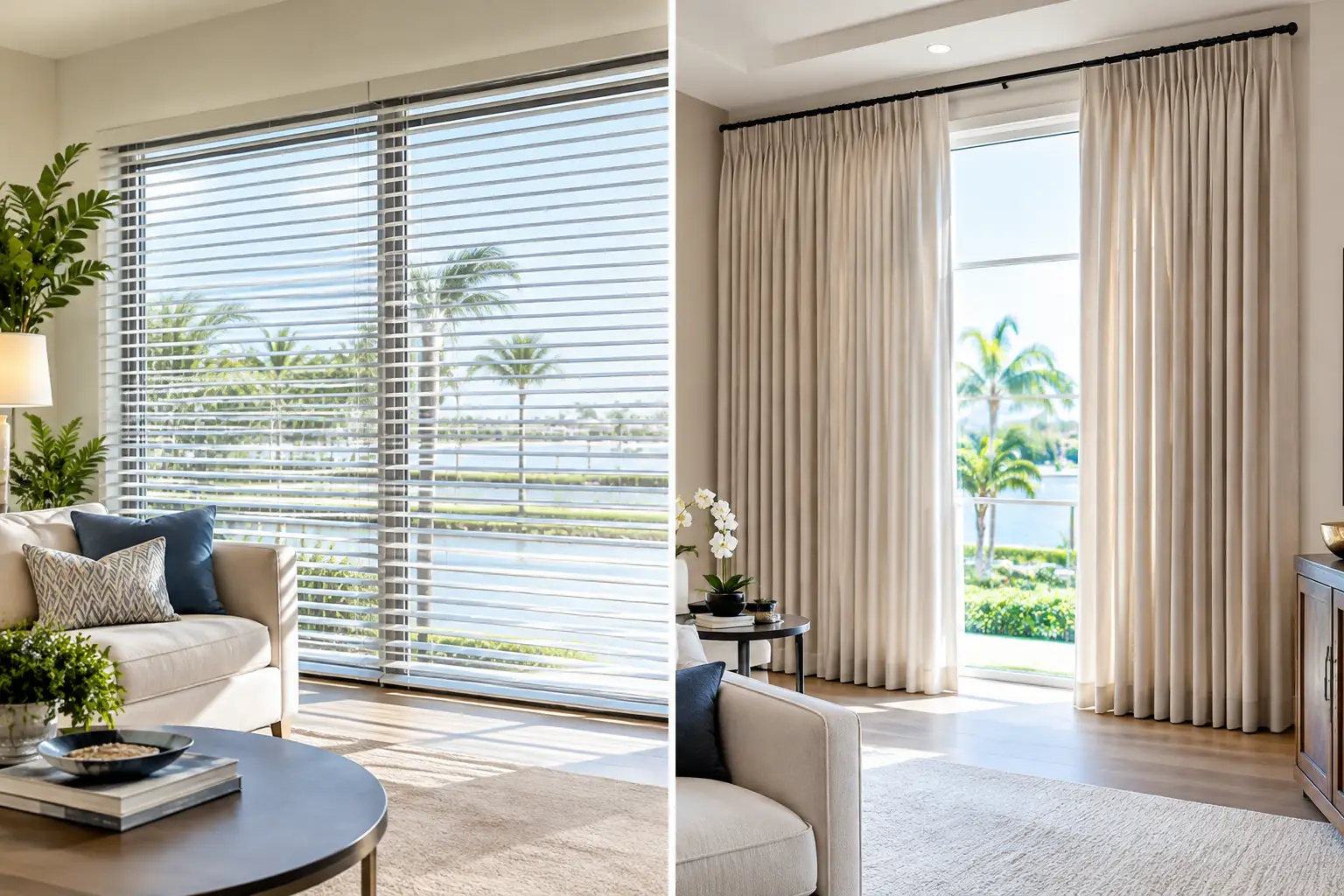
That late-afternoon Florida sun can turn a beautiful room into a place no one wants to sit. It can also fade furnishings, create glare on screens, and leave homeowners choosing between keeping the view and keeping the room comfortable. When considering blinds versus draperies, the right answer depends on how you use the room, what the windows face, and how much design presence you want the treatment to have.
Both options can make a meaningful difference in a home. Blinds bring precise light control and a clean architectural look. Draperies add softness, dimension, and a more tailored decorative finish. In many Boca Raton-area homes, the strongest design solution is not an either-or decision, but a thoughtfully layered combination.
Blinds Versus Draperies: The Core Difference
Blinds are hard window coverings made with adjustable slats. Depending on the material and style, those slats may be wood, faux wood, aluminum, or composite. Their defining advantage is control: tilt the slats to direct daylight, reduce glare, and maintain privacy without closing off the room entirely.
Draperies are fabric panels that hang from a rod or track. They can be stationary for decoration, operable for everyday use, or paired with a lining for greater privacy and light management. Rather than directing light in small increments, draperies generally open and close across the window in broad panels.
That functional distinction affects the look of the room. Blinds tend to feel crisp, orderly, and practical. Draperies create visual height, soften hard architectural lines, and introduce color, texture, or pattern. A contemporary office may benefit from the structure of blinds, while a formal dining room or primary bedroom may call for the warmth of custom fabric panels.
When Blinds Make the Better Choice
Blinds are especially useful where day-to-day adjustability matters. In a kitchen, home office, family room, or room with strong eastern or western exposure, adjustable slats allow you to manage changing sunlight without losing all natural light. This can be particularly valuable in South Florida, where glare and intense sun are regular concerns.
Faux wood blinds are often a practical consideration for humid areas, including bathrooms, laundry rooms, and homes near the coast. They offer the classic appearance of painted wood while standing up well to moisture. For homeowners who prefer a more natural finish in a climate-controlled living space, wood blinds can bring rich texture and a refined, furniture-like quality.
Blinds are also a good fit for windows that need privacy but still benefit from airflow and daylight. Tilted slats can obscure a direct view into the room while allowing light to filter through. That flexibility is difficult to duplicate with standard fabric panels alone.
The trade-off is that blinds have a more defined, linear appearance. They can complement a room beautifully, but they rarely create the same sense of softness or scale that full draperies can provide. They also have individual slats that require periodic dusting, particularly in rooms with open windows or frequent activity.
Best rooms for blinds
Blinds often work well in kitchens, bathrooms, home offices, casual living spaces, and street-facing windows where privacy changes throughout the day. They are equally appropriate in professional settings where a polished, uncluttered appearance and glare control are priorities.
When Draperies Are Worth the Design Investment
Draperies change the character of a room in a way few other furnishings can. Properly measured panels can make windows look taller, broaden the visual impact of a wall, and give a room a finished, intentional appearance. This is why draperies are frequently selected for living rooms, dining rooms, bedrooms, and spaces with large windows or sliding glass doors.
Fabric also offers a broad range of possibilities. A light linen-look fabric can make a coastal-inspired room feel relaxed and airy. A textured neutral can add depth without competing with art or furnishings. A more substantial fabric can create a formal, layered look in a traditional or transitional home.
For bedrooms, lined draperies can provide stronger privacy and more effective light reduction than blinds alone. For media rooms or rooms where daytime rest is important, room-darkening lining can be a valuable option. The exact level of light control depends on the fabric, lining, panel coverage, and how closely the treatment is installed to the window.
Draperies do require more consideration at the planning stage. Fabric selection, fullness, header style, hardware, and the stack-back space beside the window all affect the final result. A panel that looks beautiful in a sample may not perform as expected if it is too sheer for a highly exposed window or too heavy for the room’s overall style. Professional measuring and design guidance help prevent those disappointments.
Best rooms for draperies
Draperies are often ideal for formal entertaining areas, bedrooms, primary suites, large picture windows, and sliding doors. They are also a strong choice when the window treatment should feel like an integral part of the interior design rather than simply a functional covering.
Light Control and Privacy: What Matters Most
For homeowners comparing blinds versus draperies, light control is often the deciding factor. Blinds offer more frequent adjustment. You can lower them for privacy, angle the slats upward to reduce glare, or open them fully to enjoy the view. This makes them especially helpful when sunlight shifts throughout the day.
Draperies offer a different kind of control. Open, they frame the view. Closed, they can provide broad coverage, privacy, and a softer filter of daylight depending on the fabric. Sheer draperies can diffuse bright sun beautifully, but they do not offer the nighttime privacy of a lined or opaque fabric.
If a room needs both soft daylight and dependable privacy, layered treatments are often the most effective answer. For example, blinds or shades can handle daily light control, while stationary drapery panels add color and finish the window. In bedrooms, an operable shade or blind beneath draperies can provide more complete coverage than either option on its own.
Maintenance and Long-Term Living
Neither choice is maintenance-free, but the work is different. Blinds usually need routine dusting or gentle cleaning of the slats. Their practical design makes them easy to use daily, though wide windows and multiple slats can take time to clean thoroughly.
Draperies collect less visible dust on a day-to-day basis but should be vacuumed gently with an upholstery attachment and professionally cleaned according to the fabric’s care requirements. Homes with pets, young children, or frequent outdoor exposure may benefit from fabrics chosen for durability and easy care.
Motorization can improve the experience of either style, particularly on tall windows, hard-to-reach openings, or wide expanses of glass. Scheduled operation can help manage harsh sunlight during the hottest part of the day, while remote or app-based controls add convenience to the daily routine.
Style Should Follow the Architecture – and Your Routine
A window treatment should work with the home, not compete with it. Plantation-style shutters and blinds can suit homes that favor clean lines and enduring structure. Draperies can complement more traditional, transitional, coastal, or luxurious interiors, especially where furnishings and architecture benefit from softer layers.
Still, style should not outweigh function. A beautifully dressed window that cannot manage afternoon glare will become frustrating quickly. Likewise, a highly practical blind may feel incomplete in a formal room that needs warmth and visual balance. The best selection considers the view, sun exposure, privacy needs, ceiling height, furniture placement, and the way the room is used every day.
At Boca Blinds, the consultation process is designed to make those decisions clearer. Seeing materials in the home, considering the direction of the light, and reviewing how each window operates leads to a more confident custom solution than choosing from a small sample in isolation.
The window treatment that serves you best is the one you will enjoy using long after the installation is complete. Whether that means the crisp control of blinds, the tailored elegance of draperies, or both together, begin with the needs of the room and let the design follow.