

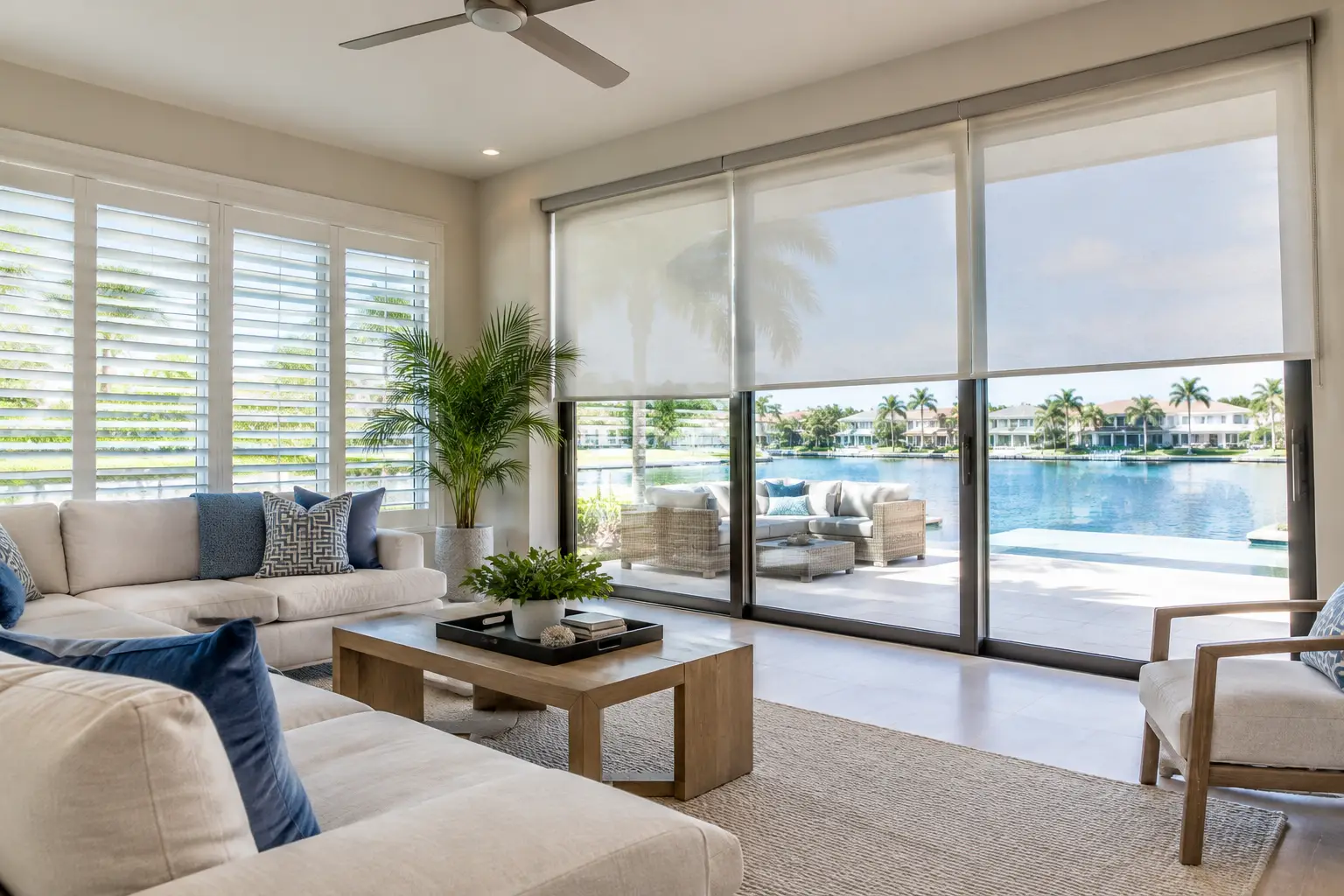
A patio door is often the brightest opening in the home and one of the hardest to cover well. The best patio door coverings should soften strong South Florida sun, protect privacy after dark, and still let you move easily between your living space and the patio. That balance is why the right choice is rarely a standard, off-the-shelf blind.
A beautiful treatment must also suit the way the door operates. Sliding glass doors need coverings that stack neatly to the side. French doors need a solution that clears handles and moves with the door. Large panels of glass may call for motorization, especially when they face the afternoon sun. The details matter, both for daily comfort and for the finished look of the room.
What Makes a Patio Door Covering Work Well?
Before choosing fabric, color, or style, consider the role your patio door plays in the room. Is it your main source of natural light? Does it face a pool, neighboring home, golf course, or water view? Is glare making it difficult to watch television, work, or enjoy the space during the day?
For many homeowners in Boca Raton and nearby communities, solar control and privacy are equally important. Glass doors can admit considerable heat and ultraviolet exposure, particularly on west-facing walls. A well-selected covering can reduce glare, filter harsh light, and help protect flooring, furnishings, and artwork from fading without making the room feel closed in.
The best option also needs to match the door’s movement. Treatments should not drag, snag, interfere with a handle, or require you to wrestle with cords each time someone steps outside. A custom consultation is valuable here because measurements, stack-back space, hardware placement, and door clearance can change which products are appropriate.
The Best Patio Door Coverings by Need
There is no single best treatment for every patio door. The ideal choice depends on whether your priority is light filtering, insulation, a clean contemporary look, architectural detail, or flexible privacy.
Vertical Blinds for Practical Coverage
Vertical blinds remain a practical choice for wide sliding glass doors. Their panels turn to direct light and can pull to one side for full access to the patio. They are especially useful when homeowners want a straightforward solution that visually follows the door’s horizontal layout.
Today’s vertical blind options can feel more polished than the styles many people remember. Quality materials, coordinated valances, and carefully selected colors create a cleaner result. They are a sensible fit for casual rooms, offices, and larger openings where easy operation is the first priority.
The trade-off is stylistic. Vertical blinds tend to read as more functional than soft shades or drapery. In a formal living room or a highly designed great room, another option may provide a more elevated finish.
Panel Track Blinds for Wide Glass Doors
Panel track blinds are an excellent choice for expansive sliding doors and contemporary interiors. Broad fabric panels glide across a track and stack in a tidy group when opened. Because the panels are wider than vertical blind vanes, they create a calm, tailored appearance across large spans of glass.
This style is available in light-filtering and room-darkening fabrics, giving homeowners considerable control over the view and sunlight. A solar-screen fabric can maintain an outward view while reducing glare, while an opaque fabric provides stronger privacy when needed.
Panel tracks work especially well in homes with clean lines, open floor plans, and large windows near the patio door. They are less suited to narrow French doors or doors that swing into the room, where the moving panels may not have enough wall space to stack properly.
Cellular Shades for Energy Efficiency and Soft Light
Cellular shades, also called honeycomb shades, bring insulation and a softer visual effect to patio doors. Their cellular construction creates air pockets that can help reduce heat transfer at the glass. In South Florida, that added layer can make a room feel more comfortable when sun exposure is intense.
For sliding doors, vertically oriented cellular systems are designed to move side to side with the opening. For French doors, individual shades can be fitted to each door panel. This makes cellular shades a strong option for homeowners who want privacy and energy-conscious performance without adding heavy fabric.
Choose the fabric carefully. A light-filtering cellular shade can create a warm glow, while a room-darkening material offers stronger privacy. Keep in mind that darker or more opaque fabrics can reduce your view during the day, so this is a choice worth seeing in person.
Roller and Solar Shades for a Modern View-Preserving Look
Roller shades offer simple, clean lines and work beautifully on many patio door configurations. On French doors, they can be mounted directly to the door when clearance allows. On wider openings, coordinated shades can be installed across adjacent sections of glass for a cohesive appearance.
Solar shades are particularly appealing for South Florida homes. They filter glare and ultraviolet light while preserving a degree of visibility to the outdoors. This can be ideal for a patio, pool area, or landscaped view you want to enjoy without the harshness of direct sun.
Openness factor makes a difference. A more open weave preserves more of the view but provides less daytime privacy and light filtering. A tighter weave offers greater shading and privacy but can feel more enclosed. At night, solar shades do not provide complete privacy when interior lights are on, so they are often paired with drapery panels or another privacy layer.
Plantation Shutters for Architectural Character
Plantation shutters create a substantial, built-in look that suits many South Florida interiors. For French doors, shutters can be custom fitted to each door, allowing the panels to move with the door while louvers adjust for light and privacy. Their crisp structure complements coastal, transitional, traditional, and Mediterranean-inspired homes.
Shutters are durable, easy to maintain, and highly effective at directing light. Tilt the louvers upward to soften daylight while limiting direct glare, or close them for more privacy. For doors that are used frequently, details such as handle cutouts and panel configuration are essential to smooth operation.
They are not the best answer for every opening. Large sliding glass doors may require a different format, and shutters create a more structured appearance than fabric-based treatments. Still, for homeowners seeking long-term architectural appeal on hinged patio doors, they are a standout option.
Drapery and Sheer Panels for a Finished Designer Look
Drapery panels bring softness, color, and visual height to a patio door wall. They can frame a sliding door, cover the glass fully when closed, and stack away when you want the view. For rooms with high ceilings or open living areas, properly scaled drapery can make the entire space feel more finished.
Sheer panels are a beautiful answer when harsh daylight is the concern but you do not want to lose the brightness of the room. They diffuse the sun and add a relaxed, elegant layer. More substantial lined drapery offers stronger privacy and can help reduce light more significantly.
This approach is often ideal for homeowners who want their patio door treatment to contribute to the room’s design, not simply solve a light-control problem. Fabric selection, pleat style, hardware, and mounting height all affect the final result, which is why professional design guidance is especially helpful.
Motorized Patio Door Coverings Add Everyday Convenience
Motorization is worth considering for tall, wide, or hard-to-reach patio doors. With a remote, wall control, or programmed schedule, shades can lower during the hottest part of the afternoon and open again when the light becomes more comfortable. It is also useful for doors behind furniture or in rooms with several large window openings.
Beyond convenience, motorization removes dangling cords and can make a large treatment easier for every member of the household to use. It is particularly appealing for homeowners who want consistent sun management without constantly adjusting each covering by hand.
Choosing the Right Style for Your Home
Start with how you use the room, then look at the door itself. A family room facing the pool may benefit from solar shades or sheers that preserve the view. A bedroom patio door may need room-darkening cellular shades or lined drapery for privacy. French doors in a formal sitting room may look best with custom shutters or tailored fabric panels.
Also consider the finish of nearby window treatments. A patio door should feel connected to the rest of the room, but it does not need to be an exact match. Coordinating color, texture, and level of formality often creates a better result than forcing every window into the same product.
At Boca Blinds, experienced design and installation support helps homeowners sort through these practical and visual decisions before anything is ordered. Custom measuring is especially important for patio doors, where a small clearance issue can affect how a treatment functions every day.
The right patio door covering should make your home feel more comfortable without asking you to give up the light, view, or easy access that made the door appealing in the first place.